Why you should be cautious when handling festive season stories
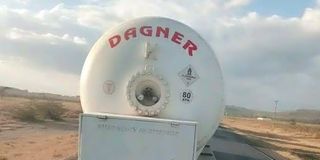
DAGNER? This is a “word” that doesn’t exist in the English lexicon. We aver with confidence that the artist who handled the sign was commissioned to paint “DANGER”. Trust signwriters! PHOTO | COURTESY
It’s holiday time and our papers are awash with stories about the challenge of getting a bus ticket to the regions.
For you to travel from Dar to, say, Moshi, to reunite with your extended family, don’t be shocked if you’re asked to part with Sh80,000 for a ticket that cost you Sh42,000 last July. Take it or leave it!
Note that we’re writing Sh42,000 and Sh80,000 and not Tsh42,000 and Tsh80,000. Why, it’s nonsensical to qualify our shilling as “Tanzanian” in a local newspaper because in this country we don’t entertain the use of any shilling other than that which Tanzanian!
A Thursday, December 11 story that appears in the tabloid associated with columnist, has a story entitled, ‘New dispensary brings healthcare closer.’ Therein, a senior Barrick North Mara mine official is quoted as purportedly saying: “Since 2020, the mine has invested Tsh54 billion in…”
We reiterate our critique on the irrelevance qualifying Bongo’s revered shilling as Tanzanian since no one in his right senses would think the amount the philanthropic BNM official stated was in Kenyan or Ugandan shillings!
In regard to travel stories, we also need to caution our scribbling colleagues on the erroneous use of the expression “passenger bus”. All dictionaries available to us define “bus” as a large road vehicle that carries passengers. It means, saying a “passenger bus” is entertaining nonsensical redundancy!
You’re, however, free to talk of a passenger train—a train the carries people, setting it apart from trains that carry goods—freight trains.
I a past article, this writer recalls, a reader questioned our assertion that a bus is just that—a bus! The reader pointed out that there’re SCHOOL buses and STAFF buses. Our response was simple, in which case we argued that there’s nothing contradictory in regard to our assertion because the former refers to a bus whose passengers are PUPILS and the latter is a bus whose passengers are EMPLOYEES of an entity.
Take note too, that short for Christmas is Xmas, not X-mas or Xmass!
Bongo’s huge and colourful broadsheet of Wednesday, December 10, has a Page 1 story whose headline reads, ‘Government steps up digital leap as connectivity increases.’ The scribbler writes in Para 4: “This expansion of connectivity has fuelled a surge in usage with the REGULATOR playing a pivotal REGULATORY role.”
Do we have to say it? Well, let’s do it. The use of the word “regulatory” after the adjective “pivotal” is a sheer waste of space. Why, telling your esteemed reader that a regulatory outfit played a regulatory role is saying the obvious, something that must avoided if we’re to subscribe what we call in journalese “word economy”.
We note two more cases of insensitivity to word economy on Page 3 where a scribbler, one GG, says in her intro: “Pharmacist JM has been arraigned before the Kisutu Resident Magistrate’s Court in Dar es Salaam facing SERIOUS criminal charges linked to theft of medical supplies and hospital equipment valued at Sh9 billion…”
The scribbler has no business telling us what the charges which the accused is facing are a “serious” even if the allegedly stolen stuff is worth Sh9 billion. Let such adjectives come from the mouth of the DPP who’s keen to impress and influence the magistrate.
And now, a look at Bongo’s senior-most broadsheet of Saturday, December 13, whose Page 2 is carrying five stories, three of whose headlines read:
• YOUTH urged to use online platforms to earn income;
• Bagamoyo YOUTH equipped with life, vocational skills and
• Vuo YOUTH lead change in marine conservation.
We’d rather the revise editor who handled the whole page before it was dispatched to the printer’s got rid of two “youth” to reduce monotony. So we’d have something like: ‘Graduands equipped with life, vocational skills’ AND ‘The YOUNG in Vuo lead in marine conservation’