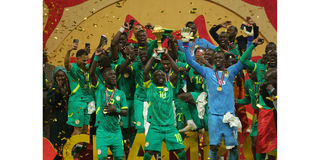
The ruling marks a significant and unprecedented moment in AFCON history, as a final match result is decided administratively rather than on the pitch
Dar es Salaam. The African football governing body (CAF)’s Appeal Board has officially awarded the 2025 Africa Cup of Nations (AFCON) final to Morocco after ruling that Senegal forfeited the match, bringing a dramatic conclusion to one of the tournament’s most controversial episodes.
According to the statement released on Tuesday on March 17, 2026, CAF confirmed that the Senegal national team had breached tournament regulations, leading to the forfeiture of the final match of the AFCON Morocco 2025.
As a result, the match has been recorded as a 3–0 victory in favour of the Morocco football governing body (FRMF), effectively handing Morocco the continental title.
The ruling followed an appeal lodged by the Moroccan federation challenging the initial decision made by the CAF Disciplinary Board.
The Appeal Board declared the appeal admissible and upheld it in full, overturning the earlier verdict.
According to CAF, Senegal’s conduct fell within the scope of Articles 82 and 84 of the AFCON regulations, which govern misconduct and match forfeiture.
The board concluded that the Senegal football governing body (FSF), through the actions of its team, had infringed these provisions, warranting the severe sanction.
“The protest lodged by the FRMF is upheld,” the statement read, confirming that Senegal’s actions directly led to the forfeiture decision and the awarding of the match to Morocco.
In addition to the headline ruling, the Appeal Board also addressed several disciplinary matters arising from the match.
Moroccan player Ismaël Saibari was found guilty of misconduct under Articles 82 and 83(1) of the CAF Disciplinary Code.
However, his punishment was reduced, with the board imposing a two-match suspension, one of which is suspended, while rescinding a hefty $100,000 fine previously issued.
CAF also reviewed incidents involving match organisation and fan behaviour.
The Moroccan federation was held responsible for the conduct of ball boys during the match, though the fine related to this incident was reduced to $50,000.
Meanwhile, the Appeal Board upheld a $100,000 fine against Morocco for interference around the OFR/VAR review area, signalling CAF’s firm stance on protecting the integrity of match officiating processes.
Another partially successful appeal concerned the use of lasers during the match. While the board confirmed Morocco’s responsibility, it reduced the associated fine to $10,000.
The ruling marks a significant and unprecedented moment in AFCON history, as a final match result is decided administratively rather than on the pitch.
It also underscores CAF’s strict enforcement of its regulations and its willingness to impose decisive sanctions in cases of misconduct.
For Morocco, the decision confirms their status as AFCON 2025 champions, albeit under unusual circumstances.
For Senegal, it represents a major setback and a reminder of the consequences of regulatory breaches at the highest level of African football.
The outcome is likely to spark debate across the continent, with fans and analysts reflecting on both the events of the final and the broader implications for discipline and governance in African football.