Working together for sustainable progress this St Patrick’s Day
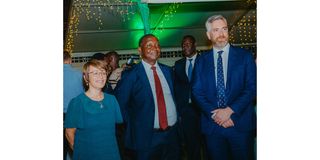
Ireland’s Minister of State for Nature, Heritage and Biodiversity Mr Christopher O’Sullivan (right), Minister of Education, Science and Technology Professor Adolf Mkenda (centre) and the Ambassador of Ireland to Tanzania Ms Nicola Brennan (left) in a group photo during the Embassy of Ireland St Patrick’s Day Reception.
In a world as fast-moving and unpredictable as the one we are navigating currently, it is comforting to know there are predictable lighthouses on the horizon and a few certainties upon which we can depend.
St. Patrick’s Day, every 17 March, provides one such occasion that Irish people, and people of Irish heritage, will be keen to celebrate all over our world, including here in Tanzania.
For those, and for all who call Irish people their friends, this really is a global celebration of Irish history, culture, connections and shared values.
Ireland is proud of its long-standing partnership of over 45 years with Tanzania. Our joint history reflects our common interest in sustaining economic and social progress for all Tanzanians, while also ensuring accountable institutions and peaceful, democratic governance.
Here in Tanzania, we are honoured by the second Ministerial visit from Ireland in two years. Christopher O’Sullivan, Ireland’s Minister of State for Nature, Heritage and Biodiversity, joined us in celebrating our national day.
During his visit he held bilateral meetings with government Ministers, and various partners in the business and environmental sectors. Ireland may feature near the top of the UN’s Human Development Index today, but this was not always the case.
And though Ireland’s story of sovereignty and independence is now more than 100 years old, it is only in the last half a century and in the 53 years since we joined the European Union, to be more precise – that our economy has grown exponentially and our society has learnt to be more tolerant, more equal and more inclusive.
Ireland’s Minister of State for Nature, Heritage and Biodiversity Mr Christopher O’Sullivan (left), the Ambassador of Ireland to Tanzania Ms Nicola Brennan (right) pose for a group photo with Sr Nora (seated),the oldest Irish citizen in Tanzania.
It is these latter values, together with our commitment to human rights, international law and multilateralism, that we will champion if we are successful in our bid for membership of the UN’s Human Rights Council from 2027 to 2029.
Ireland will take on the mantle of the Presidency of the Council of the European Union in July 2026 for the eighth time, at a juncture when global challenges have rarely looked so formidable.
It is a time when we need to look at how we strengthen our strong partnerships between European and African countries, including Tanzania. Ireland is working with other EU Member States for an ambitious and effective EU-Africa partnership, both during and beyond our EU Presidency. The EU and its Member States are the largest donors of Official Development Assistance (ODA) in the world, accounting for 42% of global ODA in 2024.
By working together, Team Europe – including Ireland, is responding to global challenges and advancing collective sustainable development objectives. Here in Tanzania, Ireland’s development cooperation focuses on reducing poverty, advancing gender equality, strengthening access to justice and health, and supporting inclusive development.
To quote Minister O’Sullivan: “Ireland recognises that development gains are most durable when they are underpinned by good governance, respect for democratic principles and civic participation.”
But the relationship between Ireland and Tanzania goes well beyond ODA and we recognise the great potential for significant trade and investment in Tanzania as well as other countries in the region.
In June 2025, Ireland hosted the Africa Ireland Trade Conference in Dublin. This event explored and promoted new opportunities for trade and investment between Ireland and the countries of Africa.
It provided a platform for dialogue and networking between business and political leaders and public and private sector representatives from across Ireland and Africa.
Fourteen African countries were represented, including from Tanzania. As we witness the continuing and new conflicts across the world, we are more determined than ever to work with others to reach resolution and lasting peace to those impacted.
We know from our own history, and the violence in Northern Ireland between the 1960s and 1990s, that conflict resolution is never straightforward, or without difficult compromises.
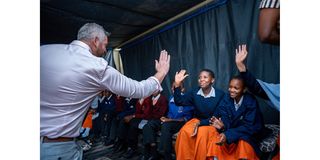
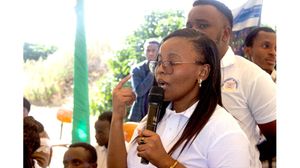
Ireland’s Minister of State for Nature, Heritage and Biodiversity Mr Christopher O’Sullivan (left) inter acts with Roots & Shoots club youth members, during his visit to Arusha.
Open dialogue and reconciliation are essential elements on the road to lasting peace. As Minister O’Sullivan said during his visit: “Reconciliation requires courage to listen and to acknowledge difficult truths, and patience to build trust over time. Independent institutions, open dialogue and transparency all play a vital role in rebuilding confidence and ensuring that societies emerge stronger from moments that truly challenge us.”
The Presidential Commission of Inquiry offers Tanzania an opportunity to demonstrate its commitment to truth, accountability and reconciliation. At a time of much turbulence, there is strength in Irish stability and our sustained commitment to our long-term partnerships with countries such as Tanzania.
Predictability rarely makes for dramatic breaking news – but it can produce a great location to invest, visit, study and do business. This is Ireland in 2026, a country with lots of challenges, domestically and internationally, but also one well-placed to lead a strong national and European response to achieve peace. An ambition worth toasting together this St. Patrick’s Day!