Mwinyi calls for continued honour of Karume’s revolutionary legacy
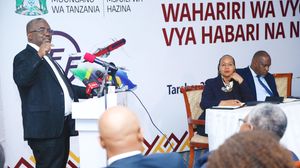
Zanzibar Second Vice-President speaks on behalf of President Hussein Mwinyi at the eighth memorial symposium for the late Abeid Amani Karume, held at the Mwalimu Nyerere Memorial Academy, Karume Campus, in Unguja, Zanzibar. PHOTO | JESSE MIKOFU
Speaking at a symposium held at the Mwalimu Nyerere Memorial Academy, Dr Mwinyi said the revolutionary leader laid the foundation for justice and dignity
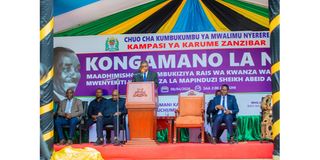
Unguja. President Hussein Mwinyi yesterday said there is every reason to continue honouring the late Abeid Amani Karume for his courage in leading the Zanzibar Revolution, which he said ended a period of oppression on the Isles.
Speaking during the eighth Karume memorial symposium held at the Mwalimu Nyerere Memorial Academy, Karume Campus, Dr Mwinyi said the revolutionary leader laid the foundation for justice, dignity and unity among Zanzibaris.
He said that following the Revolution, Karume championed equal rights for all, improved social services and sought to eliminate injustice.
“In carrying forward his legacy, the Revolutionary Government of Zanzibar will continue strengthening social services, promoting investment and expanding employment opportunities, in line with his vision of rejecting oppression,” said Dr Mwinyi said in a speech read on his behalf by the Second Vice-President, Mr Hemed Suleiman Abdulla.
He quoted Karume as saying the Revolution brought freedom and restored dignity to Africans who had been subjected to colonial humiliation. He noted that the remarks reflected a genuine commitment to liberation, unity and development.
Dr Mwinyi said the symposium, which brings together different groups to reflect on Karume’s ideas and vision, should serve as a platform to promote and implement his philosophy in society and workplaces.
Referring to the theme, “The vision of Sheikh Abeid Amani Karume in strengthening nationalism and a sustainable economy,” he urged participants to translate those ideals into practical actions that accelerate Zanzibar’s economic growth while preserving peace and social cohesion.
He noted that Karume stood firmly against all forms of discrimination, regardless of social status or religion.
“It is important to uphold a culture of solidarity, love and equality, while leaders continue to fulfil their responsibility of delivering development in partnership with citizens,” he said.
Dr Mwinyi also emphasised Karume’s role in fostering unity, noting that his commitment to national cohesion contributed to the formation of the United Republic of Tanzania on April 26, 1964.
He said it remains a collective responsibility to safeguard the legacy of the Revolution and the Union for present and future generations.
Chairman of the academy’s board, Mr Stephen Wasira, said the primary goal of the Revolution was to deliver economic development and establish the rule of law.
He noted that it introduced equal rights, land redistribution and fairness in governance, eliminating discrimination that had previously characterised Zanzibar society.
“Today, we remember not only Karume but also the achievements of the Revolution in fostering unity. There is no longer discrimination as existed in the past,” he said.
Mr Wasira added that about 60 percent of graduates from the institution are women, highlighting progress in gender inclusion compared with the pre-revolution period, when women had limited access to education.
He said the academy organises annual symposia to educate young people on the contributions of the nation’s founders. He warned that without such efforts, younger generations might overlook the struggles that secured present-day rights.
“If we do not tell these stories, young people may assume that current freedoms have always existed, yet there were individuals who fought for these rights,” he said.
The Rector of the academy, Prof Haruna Mapesa, said the institution offers training in social sciences, leadership, ethics and governance, as well as research and consultancy services to both public and private institutions.
He said the academy continues to serve as a centre of knowledge and leadership development, contributing to national unity and socio-economic progress.