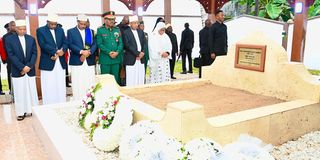
Those in attendance included Prime Minister Mwigulu Nchemba, Retired Zanzibar President Ali Mohamed Shein, Chief of Defence Forces Jacob John Mkunda and members of Karume’s family
Dar es Salaam. President Samia Suluhu Hassan and Zanzibar President Hussein Ali Mwinyi yesterday led Tanzanians in marking 54 years since the death of the Isles’ first President, Sheikh Abeid Amani Karume.
Those attending included Prime Minister Mwigulu Nchemba, Retired Zanzibar President Ali Mohamed Shein, Chief of Defence Forces Jacob John Mkunda and members of Karume’s family.
National leaders, religious figures and political analysts reflected on a legacy that continues to shape the country’s unity, governance and social outlook.
The commemoration began with prayers at the CCM Kisiwandui headquarters in Zanzibar, where Karume was assassinated.
Senior government officials, religious leaders and members of the diplomatic corps used the occasion both to remember him and to reaffirm the values that defined his leadership.
Dr Mwinyi, who also chairs the Revolutionary Council, led the congregation in special prayers known as Hitma, including recitations from the Holy Quran.
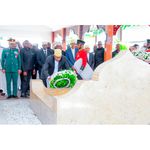
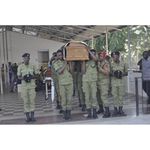
President Hassan, attending as the Guest of Honour, joined the prayers before laying a wreath at Karume’s grave.
The presence of both leaders was widely seen as a symbol of the Union between the mainland and Zanzibar, a principle closely associated with Karume’s leadership alongside Julius Nyerere.
The Chairman of the Tanzania Reconciliation and Peace Association (JMAT), Sheikh Alhad Musa Salum, described Karume as a leader whose influence extended beyond Zanzibar.
“The best of people is the one who benefits people the most,” he said, noting that Karume instilled courage and a sense of collective responsibility, laying “foundations of humanity” that continue to unite Tanzanians.
“There are people who have died but whose goodness has not died,” he added.
The Mufti of Zanzibar, Sheikh Saleh Omar Kabi, highlighted Karume’s commitment to social justice, recalling his insistence on prioritising citizens’ welfare.
“I will not go on the Hajj pilgrimage until I see that every Zanzibari lives in a good place, eats well and dresses well,” the Mufti quoted.
Interfaith solidarity featured prominently, with Father Stanley Lichenga offering prayers for the nation’s leadership.
“Remember those who led you… and imitate their faith,” he urged, calling on current leaders to uphold the values of their predecessors.
The Member of the East African Legislative Assembly, Mr Abdulla Asnuu Makame, said Karume aimed to improve living conditions for Tanzanians after the Revolution.
He noted that subsequent leaders built on his vision to foster African unity.
“To revive his dream is to advance the African unity he desired. Those outside Africa see us as one; if we remain divided, we risk exploitation,” he said, adding that praying for leaders is a lesson for future generations.
He called on Zanzibaris to live in unity, peace and solidarity, as Karume wished.
“Our leader brought peace; without it, development cannot exist. We must cherish and practise this for future generations,” he said.
The late Karume’s son, Ambassador Ali Abeid Karume, said his father secured true independence for Zanzibar, allowing citizens to elect their President and Parliament for the first time.
“Mzee Karume helped establish democracy; he promoted a system where leaders are accountable to the people,” he said.
Analysts noted that Karume’s legacy remains central to Tanzania’s identity, particularly in unity and social welfare.
The Mwalimu Nyerere Foundation (MNF) Chairman, Mr Paul Kimiti, said Karume promoted national cohesion, insisting that people live as brothers, which made the Union possible, “There is no value in talk of Zanzibar versus Tanganyika today.”
Political analyst Ali Makame Ussi said Karume’s policies directly improved citizens’ lives, citing housing programmes, welfare initiatives and universal pensions for the elderly. “Despite limited formal education, he demonstrated remarkable wisdom in addressing ordinary needs,” he said.
Social policy analyst Prof Ibrahimu Tambu added that Karume prioritised social welfare, including free education, healthcare and housing, particularly after the Revolution, though some services now require citizen contributions.
On the economy, political analyst Salma Mbarouk said Karume relied on cloves as Zanzibar’s main source of foreign exchange, enabling the state to finance social services.
“Greater economic diversification would have strengthened this model,” she noted.
Karume’s enduring legacy, analysts agree, is reflected in national unity, social welfare and a vision that continues to guide Tanzania’s progress.
Reported by Julius Maricha and Tuzo Mapunda in Dar es Salaam and Jesse Mikofu in Unguja.