Mwinyi outlines three key constraints as $300 million mega-port breaks ground
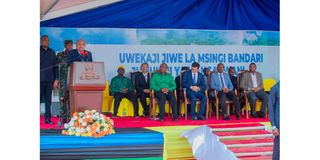
President of Zanzibar, Dr Hussein Mwinyi, addressing citizens and leaders after laying the foundation stone for the construction of the Mangapwani Integrated Port in North Unguja Region, Zanzibar.
The President called on residents to cooperate with the project, assuring them that compensation and resettlement processes would be handled fairly.
Unguja. Zanzibar President Hussein Ali Mwinyi has identified three critical constraints holding back the Isles’ economic expansion while unveiling plans to tackle them simultaneously through a landmark infrastructure project.
According to the isles’ leader, port congestion, unreliable power supply and limited fuel storage are among the key barriers to optimal performance of the economy.
Speaking on Sunday, March 22, 2026, after laying the foundation stone for the Mangapwani Integrated Port in North Unguja, Dr Mwinyi said that although Zanzibar’s economy has maintained steady growth of between 7.1 and 7.4 percent, structural bottlenecks continue to limit its full potential.
A view of how the Mangapwani Integrated Port will look upon completion in North Unguja Region, Zanzibar.

“Our economy is growing at a commendable pace, but three major constraints are holding us back from achieving faster and more inclusive growth,” he said.
Dr Mwinyi pointed to the ageing Malindi Port, constructed in 1920, as a key limitation.
The facility, he noted, is severely congested and cannot be expanded, leaving vessels to queue for extended periods because of a single, small berth.
On energy, he said Zanzibar’s reliance on electricity from Mainland Tanzania is no longer sufficient to meet rising demand, underlining the urgency of investing in additional and reliable power sources.
The third challenge, he added, is inadequate fuel storage capacity, which inflates costs.
Imported fuel must first be offloaded in Dar es Salaam or Tanga before being shipped to Unguja, adding logistical expenses that are ultimately passed on to consumers.
The Mangapwani Integrated Port project is designed to address all three constraints through one coordinated intervention.
“We have taken a deliberate decision to resolve these challenges at once,” Dr Mwinyi said.
“This port will be unlike any other in East Africa, capable of handling modern container vessels carrying up to 15,000 containers,” he added.
Dr Mwinyi said that Mangapwani is set to position Zanzibar as a regional hub for container trade, strengthening its competitiveness within East Africa.
Alongside the port, he said the government will construct fuel storage facilities with a capacity exceeding 60 million litres, enough to meet domestic demand for more than three months, noting that the move is expected to stabilise supply and reduce fuel costs.
A view of how the Mangapwani Integrated Port will look upon completion in North Unguja Region, Zanzibar.

In addition, a 200-megawatt power generation facility will be installed at the same site, ensuring energy security for at least the next 15 years.
“Once these three projects are completed, Zanzibar’s economy will take off. We are already among the stronger economies in East Africa, but this will elevate us to a new level,” he said.
The President called on residents to cooperate with the project, assuring them that compensation and resettlement processes would be handled fairly.
“The government recognises its obligation to compensate affected residents and provide decent housing. Everyone will receive their rightful entitlements, and no one will be disadvantaged,” he said.
Project scope and timeline
Providing technical details, Permanent Secretary in the Ministry of Works and Transport, Mr Ali Said Bakari, said the project is valued at $300 million (over Sh770 billion) and commenced in September 2025 with the completion scheduled for September 2028.
The port will feature three berths, including a main berth stretching 680 metres with a depth of 20 metres, capable of accommodating large container vessels of up to 200,000 tonnes.
According to Mr Bakari, no other port in East Africa currently matches this capacity.
The facility will also include dedicated areas for container handling, general cargo, a container freight station (CFS), administrative buildings, independent power systems and advanced communication and security infrastructure.
Two additional berths, each measuring between 217 and 220 metres with a depth of 15 metres, will handle vessels of up to 30,000 tonnes. A smaller berth will be designated for vehicle offloading.
The port will initially handle up to 200,000 containers and one million tonnes of general cargo annually, with provision for future expansion to one million containers per year.
“All key feasibility studies, covering soil, ocean waves, water depth and environmental impact, have been completed,” Mr Bakari said, noting that preliminary works, including site clearance and construction of support infrastructure, are already 14 percent complete.
The Zanzibar Ports Corporation (ZPC) Managing Director, Mr Akif Ali, said the facility will serve both domestic cargo and transshipment operations, occupying 18 hectares in its first phase.
Minister for Works and Transport, Mr Khalid Salum Mohamed, described the project as a transformative milestone for the isles, urging citizens to seize emerging opportunities.
“This port will be a game changer, strengthening both household incomes and the national economy,” he said, adding that it will boost employment and improve connectivity across Zanzibar, particularly in the northern region.