Zanzibar's Sh40 billion market faces crisis just a year after launch

Traders at the Sh40 billion Chuini Modern Market in Zanzibar's Urban West Region display their produce amidst complaints of a severe customer shortage, expressing fear that the situation is eroding their capital. The challenges came to light on Saturday, July 18, 2026, during a tour of the market by the Isles’ Second Vice-President, Mr Hemed Suleiman Abdulla. PHOTO | JESSE MIKOFU
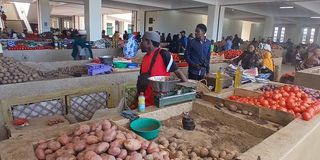
Unguja. Nearly a year after the inauguration of the Sh40 billion Chuini Modern Market in Zanzibar’s Urban West Region, traders are lamenting a severe customer shortage that they warn is eroding their capital.

Zanzibar President Hussein Ali Mwinyi launched the modern facility on September 20, 2025, to bring services closer to consumers and boost traders’ incomes.

However, traders contend that the absence of a wholesale produce auction has left the market deserted, as buyers prefer competing trade hubs.

Speaking on Saturday, July 18, 2026, during a tour of the market by Zanzibar’s Second Vice-President, Hemed Suleiman Abdulla, traders noted that their agricultural produce was rotting due to low footfall.

A spice and produce vendor, Fwarda Saidi Ali, said that despite paying a daily market levy of Sh2,000, amounting to Sh60,000 monthly,  business has remains stagnant.

“Our bananas frequently rot before we find buyers because we lack an on-site auction. We urge the government to relocate the banana auction here to revive our businesses,” pleaded Ali.

Another trader, Mr Said Khamis Said, warned that many vendors who secured commercial bank loans are on the verge of default due to collapsing sales.

Responding to the grievances, Urban West Regional Commissioner Mohamed Abdalla stated that regional authorities had already designated Chuini Market to host the wholesale auction for all bananas cultivated on Unguja Island.

Its Mombasa Market counterpart will handle banana auctions for produce arriving from Pemba Island to stimulate trade across both facilities.

The Regional Commissioner revealed that the Chuini auction was scheduled to commence on Saturday, July 18, 2026, but officials failed to implement the order, prompting the government to threaten enforcement.

“We held consultative meetings and agreed on the framework. The banana auction was supposed to start today, but what we see is outright defiance. We will enforce this directive, and non-compliant parties will face disciplinary and legal action,” warned Mr Abdalla.

Addressing the traders, Mr Abdulla emphasised that the government invested heavily in the infrastructure to lift livelihoods, noting that traders' investments must be safeguarded.

He stressed that public markets must be managed equitably to benefit all stakeholders rather than favouring specific cartels.

“I am directing that this issue be resolved immediately. Under the current circumstances, a wholesale auction must be established at this market. This matter is not open for debate,” directed the Vice-President.

During a subsequent tour of Jumbi Market, Mr Abdulla received complaints from traders regarding high rental fees, with several stating that they struggled to afford the Sh40,000 monthly charge.

Traders at Jumbi Market strongly opposed moving the banana auction, arguing the relocation would cripple their own businesses.

The head of produce brokers, Mr Abdalla Mwanjanga Abdalla, criticised the policy shift, warning that altering existing trade dynamics would hurt established vendors.

However, the Regional Commissioner maintained that only the banana auction would be transferred, while auctions for other fruits and vegetables would remain at Jumbi.

Representing food vendors at Jumbi, Esther Chesa, complained that authorities were violating lease agreements by crowding two or three traders into a single stall while inflating the agreed Sh40,000 rent.

In response, Vice-President Abdulla ordered municipal councils to respect binding agreements.

“If the contract stipulates Sh40,000 per stall, that is exactly what must be collected. We must honour contracts instead of manufacturing unnecessary disputes,” he said, adding that the government has set aside Sh40 billion for soft loans to empower local entrepreneurs.