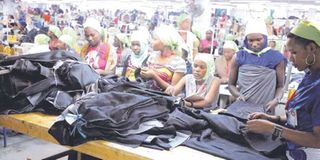
Garment workers at the Export Processing Zones Authority (EPZA) in Dar es Salaam work on clothes meant for export. PHOTO | FILE
What you need to know:
Financing of manufacturing which dominates Tanzanian industries remains low. As of now, manufacturing is the third recipient of credit extended by banks to major economic activities.
Reports indicate that it accounts for 10.5 per cent while the largest share of credit is given to personal loans which account for 27.4 per cent followed by trade at 20.5 per cent.
Dar es Salaam. As Tanzania implements its much-touted industrialisation drive, financing is still cited as one of the big hurdles the country has to address.
The industrial sector which is mostly represented by manufacturing has of late shown an improvement in terms of growth and its contribution to the economy, but access to funding remains low.
According to the Bank of Tanzania (BoT) monthly economic review for July 2018, Tanzania’s bank credit is dominated by personal loans at 27.4 per cent followed by trade at 20.5 per cent.
Manufacturing becomes the third recipient accounting for 10.5 per cent of the total credit extended by banks to major economic activities in the year ending June.
This was a slump because in the year ending June 2017, the share of credit to manufacturing was 11.4 per cent.
However, the sector has been growing and its contribution to the economy is improving.
For example, manufacturing grew by 7.8 per cent in 2016, compared to 6.5 per c ent in 2015, according to BOT Annual Report 2016/17. Much of the growth occurred in the production of food products, cement, beverages, tobacco and clothing.
On the other hand, employment in this economic activity increased to 95,678 employees in 2016 from 91,008 employees in 2015 with food, beverages and tobacco manufacturing producing more than half of the total employment, states the report.
The industrial sector financing, unlike other sectors, has challenges which may be originating from both the nature of the local financial institutions and the operational challenges of the industries.
Elaborating on the issue of long term financing, industrial economist Prof Samuel Wangwe says Tanzanian banks cannot provide long-term loans because they depend mostly on customers’ deposits.
“Development financing depends on financing by either fixed deposits or government capital and investment into banks for them to be able to provide long term loans. In the Tanzania banking industry, this is not the case and deposits are the largest source of money for lending,” says Prof Wangwe.
According to him, TIB Development Bank should play a bigger role towards supporting the industrialisation agenda.
Prof Haji Semboja, an economist, says lack of long-term credit is a big problem.
“The industrial sector, manufacturing in particular, requires long term financing while the local commercial banks prefer short-term loans to salaried employees who are perceived as less risky,” he says.
A commercial bank official who wanted to remain anonymous said long term financing like that needed by manufacturers is risky.
“Long term financing is very risky… in 10 years of loan maturity, the company can go bankrupt or anything unexpected can happen,” said the banker.
Mr Moremi Marwa who is the CEO of the Dar es Salaam Stock Exchange says that a successful and sustainable industrialisation policy and plan needs to be accompanied by important development in financial institutions.
He stresses the need to enhance national capacity to mobilise financial resources, from both domestic and external sources, and the ability to utilise those resources effectively and efficiently.
He argues that the focus has been on attracting foreign direct investments (FDIs) as a key tenet to industrial development although evidence shows that for sustainable industrialisation and its financing, the real benefits could more effectively be harnessed on the basis of a lot of other perspectives.
“Developing our local capacity in finance, skills, innovation, technology and markets is key for us to achieve the objectives as set in FYDP II. In the short to medium term, we should still focus on inducing more foreign capital flow,” he says.
He further added that there is a need to proactively and aggressively encourage domestic savings by pursuing programmes that will ensure increased financial literacy, and also introduce financial institutions and instruments that will provide an investment platform for many.
“Products such as micro savings bonds, collective investment schemes must be continuously championed by both the government and private sector using both existing and potential institutions,” he explained.