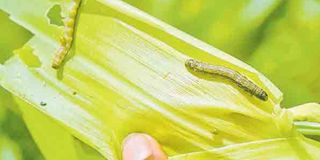
It originated from America. It was spotted in West Africa in 2016.
FAW is a trans-boundary pest whose larvae can wreak havoc on a wide range of crops. This is because the larvae eat so much of the plant. They are detrimental to crop survival and yield.
The larvae even burrow into the corn ear to eat the kernels.
The Ministry of Agriculture’s officer in charge on Invasive Alien Species and Biocontrol, Ms Beatrice Pallangyo, told The Citizen that research to identify effective natural enemies was going on and development of Integrated Pest Management (IPM) was in progress.
Public awareness will be conducted to ensure wide adoption of the IPM measures.
“To ensure sustainable management of FAW, a countrywide survey will be conducted in the next maize growing season to determine pest status, host range and natural enemies,” she said.
She said further training on extension officers was going on in collaboration with district authorities.
To address the FAW outbreak, the Plant Health Services and partners such as FAO have been cooperating to mobilise resources for its management.
Public awareness on control measures is being created and management tools including pheromone traps and pesticides distributed in affected areas.
Farmers are advised to conduct regular inspections of their fields to enable early detection of pest for timely intervention.
Hand-picking of larvae, application of ashes on infested plants, early planting, regular weeding, destruction of crop residues and application of pesticides such as Duduba 450EC, Dudual 450EC, Belt 480SC, Emamectin benzoate and Mupacron 50EC are among the recommended measures for FAW management.
She said that due to favourable conditions, the pest had spread fast.
It has been reported in more than 17 regions.
The pest feeds on more than 80 host plants and crops including cereals (maize, rice, sorghum and millets), oilseeds (cotton, sunflower and groundnuts), pulses and horticultural crops (onions, amaranthus, watermelon, capsicum among others) that are major food and cash crops in the country.
FAW generally feeds on foliage making characteristic row of perforations on the leaves. Fully grown larvae cause extensive defoliation, often leaving only the ribs and stalks of maize plants.
The larvae burrow into the growing point and affect the growth of plants. They can also bore into the ear through the husk and feed on kernels and sometimes can cut young maize plants and kill them.
Severe damage leading to total crop loss is common on young crop.
Considering the importance of maize as a major staple food, the FAW invasion is a threat to national food security.
Plant entomologist Maneno Chidege of the Tropical Pesticides Research Institute told The Citizen that when the pest invaded the country, they collected samples of the attack in Nkasi, Rukwa, for research.
“After the discovery, we consulted with countries like Brazil, US and others where the pest first originated to identify the type of pesticide they use and whether they can work in the country,” he said.
According to him, after they were told of the pesticides, they did research by using them in three cropping seasons to determine whether they would work both times and they did.
However he noted that while it worked at some point the pesticides refused to work because it would hide on the plant tissues to and therefore had to use a symptomatic spray system to reach and destroy it.
He named some of the pesticides they used include emamectin Benzoate 50g/l + Alphacypemethrin 100g/l, nIndoxacarb 30g/l +n Acetamiprid 16g/l among others.
However, the entomologist noted that too much pesticide affected the soil and impacted on the environment and therefore started another form of research biological control that would be more sustainable.
In another development researchers in the country are expected next month to start phase two biotech field trails research on the fall armyworm tolerant maize to establish their tolerance on the species.
A senior research officer with the Commission for Science and technology, Dr Nicholaus Nyange, said that the research on maize FAW started December last year, where maize was planted and harvested in May.
“We recorded good results but they are not enough until we conduct at least two or three research to establish whether our findings will be able to tackle the insects fully,” he said.
Dr Nyange said that so far, South Africa, Mozambique, Kenya and Uganda have conducted studies on the species and found results.
In view of this, he said that, they expect to start another round of research September this year. He said that the maize will be harvested in December to see whether the results will match with the first phase.