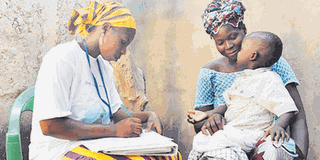
A lot has been narrated regarding the potential of this growing cadre. A CHW is chosen by community members or organisations to provide basic healthcare to the community. They are capable of providing preventive and health promotional services to these communities. In other settings, such workers have been named village health worker, community health aide, community health promoter, and lay health advisor and so on.
For many years, Community Health Workers (CHWs) are a health cadre that has been building up. Now, it’s formalised. However, it took years of experience to put them on board as community-based healthcare providers.
A lot has been narrated regarding the potential of this growing cadre. A CHW is chosen by community members or organisations to provide basic healthcare to the community. They are capable of providing preventive and health promotional services to these communities. In other settings, such workers have been named village health worker, community health aide, community health promoter, and lay health advisor and so on.
As a leader of an organization that has been working to strengthen rural workforce in Tanzania, through Benjamin W. Mkapa Foundation (BMF), it would be a gross understatement not to appreciate how CHWs can revolutionarise the way we provide primary healthcare.
It’s important to note that most parts of the country, especially the rural, badly need health workers and the demand increases year in, year out. That’s why; it was not by coincidence that we, at BMF, decided to direct our resources in supporting this cadre of health workers.
To make sure that they are sustainable and get well established within the healthcare system, we, together with development partners, supported the revision of the CHWs Training Curriculum.
And, as a result, this year, we intend to facilitate recruitment of about 800 of them, whereby we will begin to pilot this plan in May 2018 with the first phase of 215 CHWs.
We believe they are agents of change in promoting prevention, care and treatment of many health conditions, mobilisers for health insurance, and so forth.
Recruiting the CHWs means that we are giving them a chance to prove their worth. With a decade-long experience on strengthening health facilities with qualified health workers, CHWs are a cadre that we continue to uphold dearly.
The government is currently implementing projects to improve maternal and new-born health around the country. We, at BMF, as this May begins, new maternal and new born child health projects are rolling up. The successes of these projects will very much depend on how much has been invested in the Human Resource for Health.
This is our main niche and we understand this is still a grey area which requires innovative approaches to combat the situation.
We are in advanced discussions with the Government and other partners to jointly pilot innovative strategies on HRH to strengthen both public and private health sector. In this same regard, we shall be more engaged in advancing the Community Health Cadre through pilot testing, documentation and knowledge sharing national and internationally.
Our BMF-government collaboration in scaling up CHW through improved frameworks, structure and systems at the central and local government authorities on their production, recruitment and management is key. So far we have managed to harmonise CHW teaching material and teaching aides to 10 Health Training Institutions that the project is supporting.
As of now, a total of 989 students graduated from these Institutions. Apart from the training aspect, BMF support the orientation of 4 Regional Health Management Teams and 34 Council Health Management Teams all these are from the lake zone.
Apart from setting vital training and management structures, BMF is as well expecting to recruit 273 CHW through the support of Irish Aid and place them at village level.
Through this recruitment, we are expecting to reach not less than 273 villages from Chemba District (Dodoma), Itilima (Simiyu) and Misungwi (Mwanza). These, if put together with a network of civil society organizations, can make great advances in reaching out to the people who need healthcare in rural parts of Tanzania.
This is particularly anticipated as we embark into 3 new projects which require community mobilization in addressing HIV/AIDS, maternal health and reinforcing community health prevention and promotion through Community health workers.