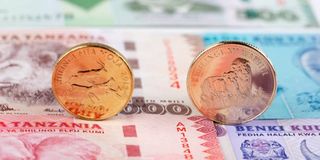
Dar es Salaam. The Tanzanian shilling has dropped against the US dollar following the escalation of conflict in the Middle East, which has pushed up global fuel prices and triggered a surge in demand for foreign exchange by local suppliers.
Market data shows that on April 28, 2026, the shilling traded within a range of about 2,600 to 2,620 per dollar, closely aligning with the central bank’s official rates of 2,589/2,615. Commercial bank quotes varied more widely, between approximately 2,560 and 2,650, depending on the institution and transaction size.
In January 2026, the Bank of Tanzania reported the Tanzanian shilling trading between Sh2,400 and Sh2,520 per US dollar.
Governor of the Bank of Tanzania, Mr Emmanuel Tutuba, said the pressure on the local currency is largely driven by higher import costs, particularly for petroleum products.
“Currently, global geopolitical tensions have increased demand for foreign exchange, largely due to rising oil import costs. As prices go up, more foreign currency is required to import the same quantity of fuel,” he said.
Global oil prices have surged sharply, rising from about $60–80 per barrel before the recent Middle East conflict escalation to roughly $100–110 per barrel in April 2026. The increase has been driven by fears of supply disruptions, geopolitical tensions, and heightened market risk premiums linked to instability in key oil-producing regions.
Mr Tutuba said despite the spike in prices, the volume of fuel imports has remained broadly unchanged, underscoring that the pressure is coming from cost rather than quantity.
However, the central bank governor maintains that the country’s external position remains stable.
“Foreign exchange reserves remain adequate, covering about 4.8 months of imports, with continued supply in the Interbank Foreign Exchange Market,” Mr Tutuba said.
Financial independent analyst, Mr Oscar Mkude, said the depreciation is consistent with typical market reactions during global shocks.
“It is true that the shilling is depreciating, which is expected during crises like these, as demand for foreign exchange rises. This is not only due to oil but also inputs such as fertilizers,” he said, describing the trend as the “first-round effect,”
He explained that higher prices and supply constraints often prompt traders to secure imports early, further driving demand for the US dollar.
“As dollar demand rises, the shilling naturally weakens. These kinds of fluctuations in the economy are normal and tend to stabilize over time,” he added.
However, he cautioned that risks remain elevated. “At the moment, risks are tilted to the upside, as the Middle East situation has not yet stabilized and geopolitical tensions persist. Continued instability will sustain high demand for the dollar and put pressure on the shilling,” he said.
Mr Mkude noted that easing the pressure will depend largely on export performance, particularly in minerals and agriculture.
“Gold prices, while fluctuating, remain relatively strong, and stronger export earnings could help cushion the shilling,” he said.
Independent financial analyst Christopher Makombe said the conflict in the Middle East has disrupted global oil supply chains, pushing international crude prices sharply higher.
“Since Tanzania imports 100 percent of its fuel requirements, and these imports are priced in US dollars, higher oil prices mean the country must spend more foreign exchange to purchase the same volume of fuel,” he said.
He noted that as a result, demand for US dollars increases in the domestic market, exerting additional pressure on the Tanzanian shilling.
He warned that this pressure on the local currency is likely to persist until a ceasefire is reached and global oil supply conditions stabilize
Reports show that immediate attention is being focused on reopening key shipping routes, particularly the Strait of Hormuz, which remains a critical chokepoint for global energy flows and is currently disrupted.
Register to begin your journey to our premium contentSubscribe for full access to premium content