A mother and her daughter fought scoliosis together
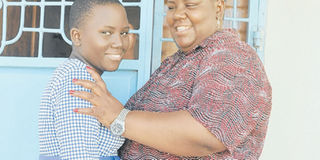
Vivian Mwankenja and her mother, Itika, share a light moment at their home in Dar es Salaam after the operation. PHOTO|SAID HAMIS
What you need to know:
It was a sight she never thought she would one day consider to be a miracle. Two years ago, in December 2014, Vivian was diagnosed with scoliosis, an abnormal twisting and curvature of the spine. It is usually first noticed by a change in appearance of the back.
Dar es Salaam. Surrounded by journalists at a Muhimbili Orthopaedic Institute ward, Itika Mwankenja sat next to her daughter Vivian, observing her sitting straight.
It was a sight she never thought she would one day consider to be a miracle. Two years ago, in December 2014, Vivian was diagnosed with scoliosis, an abnormal twisting and curvature of the spine. It is usually first noticed by a change in appearance of the back.
The 42 year old mother of identical twin daughters, Vivian and Lilian, is a secretary at the Prevention and Combating of Corruption Bureau (PCCB) in Dar es Salaam. She recalls how the past two years have been the hardest of her life.
“I nearly fainted when the doctor told me of the diagnosis. They had initially led me to believe that this was something that would go away in no time, something temporal. They were wrong,” she says, recalling the day she received her daughter’s diagnosis at Muhimbili Orthopaedic Institute (MOI).
It was at the same hospital that the thirteen year old went through a 5 hour surgery to fix her back in early October. She is the first child to go through this treatment in the country. After the surgery, journalists flocked around her and her mother.
“I will be going back to school,” she said, her face opening up to a wide smile. School was never going to be the same. As a Form One student at Muburani Secondary School in Temeke, she had been missing out on a lot as a teenage girl.
Vivian could barely walk, leave alone play with her friends and be involved in any physical activities with her peers.When her back started getting crooked, so was her soul. She felt very bad about herself, she says.
“I remember those days at school when I was not able to sit on a chair for so long. I was always tired, so I couldn’t attend classes often. The disease has affected my studies a lot. But I thank God, I am feeling much better now after the operation,” she says.
Her mother has her own memories as well. She recalls how one day her healthy child started developing an abnormal shape. Vivian’s posture changed and she started complaining of a backache. She decided to take her to the hospital.
“I was shocked to observe some changes on her back. I had never seen such a thing in my life. So I decided to take her to the hospital for further medical checkup,” she admits.
Ms Mwankenja explains how tough it was for her to cope up with the environment at the hospital in early days because she sometimes had to wait for some hours to see the doctor. Then she finally met a paediatric orthopaedic surgeon specialised in diagnosing and treating children’s musculoskeletal problems including limb and spine deformities (such as club foot and scoliosis).
“My whole family including my mother, my husband and my aunt had advised me to take her to the hospital. I am grateful for the support they showed me throughout this long journey,” she says.
The doctor had examined the abnormality on her back and referred her for an X-ray. According to the medical examination at the hospital, Vivian was diagnosed with scoliosis. A surgical procedure was necessary to treat the condition. In around eight out of every 10 cases, a cause for scoliosis is not found. This is known as idiopathic scoliosis.
A small number of cases are caused by other medical conditions, including: a condition associated with brain damage (cerebral palsy), a genetic condition that causes muscle weakness (muscular dystrophy) and a disorder of the connective tissues (marfan syndrome).
MOI Paediatric Orthopaedic spinal surgeon Dr Bryson Mcharo notes that babies can be born with scoliosis, as a result of a problem with the development of the spine in the womb.
“In adults, age related changes in the discs and joints of the spine and a reduction in bone density may cause scoliosis. Adults can also experience worsening over time of previously undiagnosed or untreated scoliosis,” he says.
Ms Mwankenja was told to return to the hospital after six months following the confirmation on the disease. The doctor intended to observe the persistence of the abnormality whether it would disappear within a short time or continue to develop. She was also instructed to keep in touch with the doctor in case something strange happens to the child.
She admits that this was a difficult time for her and her family, since they did not know what to expect. All they could do was wait.
When she wait was over, a second screening revealed that the abnormality kept existing. However, the doctor had some good news and some bad news. The bad news was that they had to operate, but they could not perform the operation in Tanzania. Patients with cases similar to Vivian’s would always be sent to India. She would have to be put on a waiting list, unless the family could come up with the money.
However, the good news was that Vivian would be the first patient to be operated in Tanzania. A delegation of foreign medical experts from the US were expected to come to Tanzania to perform the rare spinal surgeries to people with scoliosis.
The operation would be performed by local specialists in collaboration with doctors from Children’s Orthopaedics Education for Development Nations (COEDN) in the US.
“I was told that the operation was going to take place here in Tanzania at MOI for the first time. I was extremely happy to receive such information from the doctors. It was a miracle,” she says, recalling her moment of relief.
The procedure is medically known as ‘posterior spinal fusion’ with instrumentation which involves the implantation of artificial apparatuses called titanium transpedicular screws and rods tightened at the upper and lower part of the scoliotic spine to help the patient to control his or her movements.
Following the successful operation, Ms Mwankenja commends the doctors for helping her daughter to having another chance of fully participate physical activities that girls her age would want to do.
“I applaud the specialists at MOI and those from the US for saving my daughter’s life. I waited for so long to see Vivian regaining her fitness. I am extremely happy now,” Ms Mwankenja says.
She admits that the condition has had affected her daughter both physically and psychologically. She recalls on how Vivian was sometimes reminding her to attend the sessions at the hospital.
“She would always remind me to take her to the hospital. She never wanted to miss out the appointments at the hospital. It is unbelievable to see her well again,” she says.
MOI Executive Director Dr Othman Kiloloma explains that the operations will enable the government to save money that is ordinarily spending to send patients with scoliosis complications abroad for treatment.
“The government will now save at least Sh2.5 billion annually that it would have spent sending patients abroad for treatment. The government spends at least Sh2.5 billion to send patients abroad for treatment per year,” he says.
Vivian has already been discharged from the hospital and is recovering well. Her mother says that she has been instructed by the doctor to take Vivian to hospital after every six months to undergo a minor surgery purposely to adjust the screws.
“Regarding the type of the operation she had, the doctor has instructed me to monitor her doing light exercises more often. Before the surgery she was hardly walking but now she can walk long distance and she continues practicing,” she says.
Ms Mwankenja told Your Health over the phone last week that Vivian is now able to walk properly and as a mother, she could never have been happier in her life.