Mtikila carved a niche on opposition political stage
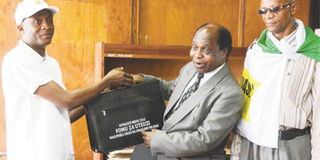
Reverend Christopher Mtikila (second left) receives presidential nomination forms from a National Electoral Commission (NEC) official. He was however disqualified over failure to meet the requisite conditions. PHOTO |FILE
What you need to know:
In the streets of Dar es Salaams, whether heading to offices of the political parties and/or the courts where he was not short of cases to answer or file, he would be followed by scores of his supporters, often carrying mini-flags.
Arusha .He would attract multitudes of people at the Mnazi Mmoja grounds and his motto would be ‘Saa ya Ukombozi ni sasa’ literally meaning the critical time for liberation is now.
In the streets of Dar es Salaams, whether heading to offices of the political parties and/or the courts where he was not short of cases to answer or file, he would be followed by scores of his supporters, often carrying mini-flags.
That was in the 1990s but specifically for his crusade for ‘liberation’ it was in early 1993, a few months after multi-party politics was officially restored in the country on July 1st 1992.
Rev Christopher Mtikila, who died in a road accident in Coast Region last Sunday, was among the early opposition leaders who met continuously in the city hotels to lay ground for the political groups that would challenge the ruling Chama cha Mapinduzi (CCM).
At that time the opposition had the likes of Mabere Marando, Masumbuko Lamwai, Maalim Seif Sharrif Hamad and were shortly later to be joined by Augustino Lyatonga Mrema and Prof Ibrahim Lipumba and others as the 1995 elections neared.
But Rev Mtikila had distinguished himself for his repeated calls for indigenisation of the economy. That made him popular with a section of the society; especially thousands of unemployed youths or petty traders and unpopular with others, specifically the Asian business community and potential investors from abroad.
For him, liberation of Tanzanians should go beyond opening doors for multi-party democracy. The economy should be in the hands of the indigenous people who, according to him, have been largely marginalised.
In his crusade for indigenisation when addressing crowds at the Mnazi Mmoja, he came up with a rather negative ‘gabacholi’ to the day to day vocabulary of the ordinary people. That implied the well-to-do who cared the less for the poor people.
During those days, he lived within the Kariakoo area, a few paces from the breweries plant and his day would begin with marching to different destinations; be it a political rally, a press conference, a meeting and later to the courts. He would even dare to storm a newsroom to make his stand explicitly known to the people.
The outspoken opposition politician was later to land in the Democratic Party (DP). He was fiercely critical of corrupt leaders and at one time took issue with the former Prime Minister Frederick Sumaye, while still serving in office, over the latter’s record in public office.
Elsewhere, he criticised the second and third phase governments of presidents Ali Hassan Mwinyi and Benjamin William Mkapa respectively on the way they handled the bloody violence and unending political crisis in the Great Lakes region.
That was shortly after the 1994 genocide in Rwanda which not only led to one of the most horrific massacres in which nearly one million people were hacked to death, but also saw an almost equivalent number of refugees from the war-torn country streaming into Tanzania.
On the constitutional front, he was an ardent fighter for the restoration of the Tanganyika government within the Union. He was convinced, like other politicians, that the set-up of the Union was rather skewed and had denied the Mainlanders of their constitutional rights, leave alone a voice in the Union government.
He fought for constitutional amendments which would allow independent candidates to contest elective posts, including the presidency. Aspirants or nominees contesting the highest office on land, he argued, should not be necessarily from the political parties
For instance, he successfully filed a case before the African Court of Human and People’s Rights (AfCHPR) challenging some clauses in the country’s mother law which barred independent candidates from contesting presidential, parliamentary and local government elections, insisting that this violated the democratic principles and the political rights of its citizens.
The case was filed before the Arusha-based Court on June 2, 2011 by the Tanganyika Law Society (TLS) and the Legal and Human Rights Centre (LHRC) on behalf of Rev Mtikila and challenged the constitutional amendments which barred ordinary Tanzanians to seek the elective posts unless they are backed by a political party.
The applicants also claimed that the Tanzania government, through certain amendments of its Constitution, violated its citizens’ right of freedom of association, the right to participate in public/government affairs and the right against discrimination by being prohibited to contest presidential, parliamentary and local government elections as independent candidates.
The current Constitution of the United Republic of Tanzania provided that a candidate had to be a member of and/or be sponsored by a political party as per the 8th Constitutional Amendment of 1992 and the 11th Constitutional Amendment Act No. 34 of 1994.
The suit further alleges that the amendments contravened Article 2 (Right to protection against discrimination of any kind) of the African Charter on Human and People’s Rights and also violated Articles 3 and 25 of the International Covenant on Civil and Political Rights (ICCPR). Tanzania is a party to both instruments of international human rights. In mid 2012, the Court, by majority, ruled that by denying its citizens to participate freely in the government of their country directly or through freely chosen representatives, the Tanzanian government had violated Articles 2, 3, 10 and 13 (1) of the African Charter on Human and People’s Rights.
It ordered the government to take “constitutional, legislative and all other necessary measures within a reasonable time” to remedy the violations found by the Court and to inform the Court of the measures taken.
But, his dispute with the government started in early 1993 after the 8th Constitutional Amendments entered into force. It was in the same year that he filed a Constitutional Case in the High Court, contending that the amendment conflicted with the country’s Constitution and was, therefore, null and void.
On October 24, 1994, the High Court delivered its judgement in Civil Case No. 5 of 1993 in favour of Rev Mtikila, declaring as unconstitutional the amendment which sought to bar independent candidates from contesting Presidential, Parliamentary and Local Government elections.
In the meantime, the Government had on October 16, 1994 tabled a Bill in Parliament (11th Constitutional Amendment Act. No. 34 of 1994) seeking to nullify the right of independent candidates to contest the said leadership positions. The Bill was passed on December 2, the same year.
Rev Mtikila, who was the leader of the Democratic Party, challenged the amendments, through High Court Miscellaneous Civil Case No. 10 of 2005.
On May 5th, 2005, the High Court ruled in Rev. Mtikila’s favour, declaring that the 11th Constitutional Amendment violated the democratic values and principles enshrined in the Constitution.
The amendments, the Court further ruled also violated the constitutional doctrine of basic structures. Although In 2009, the Attorney General Johnson Mwanyika, instituted an appeal challenging the decision of the High Court (in Civil Appeal No. 45 of 2009), the Court of Appeal reversed the Decision of the High Court.
The Court of Appeal, in its ruling, declared that the Basic Structures Doctrine does not apply to the Constitution of the United Republic of Tanzania and based on that there was no right to independent candidacy in Tanzania