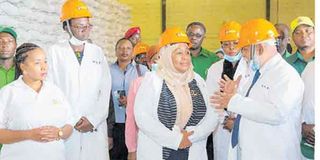
The head of the Kapunga rice project company Ltd, Nillard Chawdry gives details to the Vice President Samia Suluh Hassan who visited the project in Mbeya region recently.
What you need to know:
Until 2016, Tanzania had over 44 million hectares of arable land, but only 33 per cent is used for cultivation
Dar es Salaam. Agriculture is the main economic activity for at least 74 per cent of Tanzanians, but the sector contributes a paltry 28.4 per cent to gross domestic product.
Until 2016, Tanzania had over 44 million hectares of arable land, but only 33 per cent is used for cultivation.
Almost 70 per cent of the poor population lives in rural areas and majority of them practice subsistence farming.
Land is a vital asset in ensuring food security and crops mainly produced include maize, sorghum, millet, rice, wheat, beans, cassava, potatoes and bananas.
At the foot of Chimala Mountains at Mbarali District in Mbeya Region, the landscape supports agriculture and productivity has been boosted.
There are 5,500 hectares where paddy is grown.
The Kapunga rice project has not only become the solution for agricultural challenges, but also changes lives of small holder farmers.
Giving their experiences to the media, some farmers say they had been producing rice in small quantities before the introduction of the Kapunga project.
A small holder farmer at Kapunga village, Mr Charles Komba, says they have made huge strides with loans from financial institutions.
“Previously we couldn’t produce rice for business, we could only do so after producing surplus. Nonetheless, since the Kapunga rice project commenced, we are now sure of producing for commercial purposes,” said Mr Komba.
Evariste Mgiye echoes Komba’s argument saying, besides, acquiring farming knowledge, they have been getting inputs like fertilizers and seeds plus transportation to milling machines and markets.
Speaking on seeds quality, Stumai Tandila says she could harvest up to nine tonnes of rice from one acre, a rise from one acre per the same piece of land.
“Seeds from Kapunga are highly productive because I can now harvest up to nine tonnes of rice from one acre, a feat I could not even think about in the past,” she says.
Apart from quantity, Ms Flora Mwaipaja says its quality makes it the most preferred rice in various markets.
“Customers prefer it to other rice products. We don’t struggle to sell it at all. My life has changed significantly and now I own a motel in Mbeya. I raised my capital from my rice business,” she says.
CRDB manager for Mbarali District Ruhore Masaka said they were benefiting from the project as they were confident with credits from the small holder farmers.
“Since we started issuing loans to the farmers, we have never experienced problems because their business is reliable. They harvest and sell their crops on time and pay their debts on time,” said Mr Masaka.
The Kapunga rice project farm manager, Mr Edward Rweyendara, said they have established close ties with thousands of small holder farmers and close to 350 outgrowers by enabling them to access farms, seeds, fertilisers, equipment and transportation, to mention but a few.
“We provide the farmers with knowledge on modern farming practices. We help them to till their farms and give them seeds from Super Dakawa, which are more productive,” said Mr Rweyendara.
Apart from outgrowers, Mr Rweyendara said they were using modern technology to cultivate over 3500 hectares of tillable land.
“We employ close to 160 Tanzanians and during the season we directly engage up to 3000 labourers every day,” he disclosed.
According to him, they use mechanical transplanting, chemical spring using a boom sprayer and harvest is done by the latest version of combined harvester, which can cover 135 acres per day.
By doing so, they ensure the production of rice stands at 22,000 metric tonnes per year.
“Over 10,000 people from the neighbouring communities have benefitted directly and indirectly from various farming related operations. Our outgrowers scheme has immensely benefited small holder farmers by improving sustainability along the agricultural supply chain. We have been tirelessly working with the farmers from planting to finding the markets for their produce,” he says.
Recently Vice President Samia Suluhu Hassan visited the project when she was on an official tour of Mbeya Region.
She called for sustainability of the project in order to improve the livelihoods of the people.
“This project should be sustainable. We don’t want to hear news of failure and conflicts,” she said.
Corporate social responsibility
Apart from farming, the Kapunga rice project engages in social responsibility in which they construct and rehabilitate social services infrastructures.
The project has built Kapunga B Primary School, which can accommodate more than 300 pupils, Chimala Police Post rehabilitation and construction of Mapogoro Health Centre at a cost of Sh700 million.
The health centre is expect to serve more than 18,000 people in Mbarali District.
The health centre was inaugurated by the Vice President during her recent visit.