Tanzania’s wilderness: The unlikely friendships keeping the savannah alive

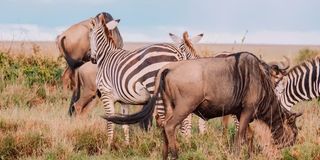
Zebras and wildebeests in Serengeti National Park.
PHOTO | COURTESY

Some of the most iconic safari moments captured on film or in still pictures are of powerful lions draped in thick honey-gold manes, pouncing on significantly larger prey. In the wilderness, it seems that every second, hunters and the hunted are in a constant chase.

To the human eye, the wilderness can appear to be a chaotic bloodbath, with merciless animals that will not cease to dig their teeth and claws into each other. But these wild animals are more collaborative than one would assume. These symbiotic relationships are vital to their survival. Oxpeckers, buffalo and rhinos are a perfect example.

Complete trust between this bird and the two giants is the foundation of their relationship. The two humongous species sit still as the tiny birds peck some of the sensitive areas of their bodies, like around their eyes.

The oxpeckers are the last line of defence against ticks and fleas suckling blood from the skin of these giants. Buffalo and rhinos employ a few tactics of their own; you would often see them rolling in mud, not only to cool their bodies during the hot heat of the day, but the mud creates an extra shell to keep the fleas at bay and when that doesn’t suffice, their symbiotic partnership with the tiny birds comes in handy.

Across Tanzania’s savannah, these two gigantic animals are some of the most powerful creatures inhabiting the wilderness. But even their thick muscles, their deadly goring and their fatal charge do not stand a chance against the micro-insects and that’s where their tiny friends come to save the day.

A tiny bird with an important life-saving job. Getting rid of ticks, fleas and parasites that bother its giant companion.

It’s termed “mutualism”; the rhino welcomes the oxpecker as a protection measure against clinging ticks, while the oxpecker removes and eats the ticks, its daily nutrients supplied out the back of its friend’s gigantic body mass. Both animals benefit from this symbiotic relationship; the oxpecker does more than just feed and eliminate parasites; it serves as an alarm for pending danger.

The aforementioned animals are vulnerable to poaching; humans are their biggest rivals. Oxpeckers tend to sense the impending encroachment or presence of humans.

Oxpeckers’ distinctive role in the lives of the big herbivorous pals has played a huge role in preserving the population of rhinos and buffalo in Tanzania, which now sits at more than 320,000, one of the largest in the world.

They are divided between the Serengeti National Park, the Nyerere–Selous Ecosystem, Ruaha–Rungwa and Katavi–Rukwa ecosystems, among other places. With Black Rhinos: population is on the pace of recovery, at approximately 280 across the country.

In Serengeti, Tarangire, Ruaha, Nyerere and Mikumi National Parks, the sausage trees have created unlikely alliances between baboons and impalas.

Bamboos are opportunistic hunters, omnivores that wouldn’t hesitate to snatch an impala fawn; a troop of baboons can even take down a grown impala. But when it’s the season of the year when the sausage tree is blooming, baboons love to eat its flower pods.

The abundance of flower pods means baboons are rarely concerned about what falls as they feed.

Much of it rains down to the ground, where patient impalas eagerly gather the leftovers. Whether the baboons do this intentionally, aware of the impala waiting below, or whether it’s simply an unintended consequence of feeding, the result is the same. Nature thrives on such quiet partnerships, where one species’ abundance becomes another’s opportunity.

In the wild, every species, directly or indirectly, depends on another. While the baboons are sort of destroying the tree on top, antelopes and sometimes warthogs enjoy the snacks down below.

The annual Great Migration, when more than a million wildebeest and hundreds of thousands of zebras traverse across the Serengeti in Tanzania into the Maasai Mara in Kenya. It has been studied by ethologists who described the two species’ journeying together as “facultative mutualism”. That goes beyond the sheer will to survive.

What makes their bond functional is that they do not compete for food; their dietary needs might be the same, but their feeding habits and parts of grass are very different, complementing each other, giving each a substantial supply of vegetation to consume. Zebras have very strong front teeth and digestive systems. This makes them suitable to eat tall and coarse grasses.

Zebras are selective of what they consume, with an ability to choose the most nutritious grasses and tall vegetation.

In doing so, they serve as lawnmowers for wildebeest that eat more quantity but indiscriminately, oftentimes grazing on short, fresh shoots that are exposed after zebras have foraged across the greenlands.

Their friendship is heightened during this yearly trek, which has attracted not only tourists from across the globe, but also predators like lions and hyenas that are always lurking.

Zebras have excellent eyesight, with the ability to spot danger from afar, while wildebeest’s sense of smell is remarkable. These two superpowers insulate them against constant ambushes.

The road to Maasai Mara and back is long and treacherous. Zebras have good memories of migration routes and water sources, which makes their travel quicker and ensures that they are on the right path with access to water bodies.

Their strength in numbers helped keep the carnivores at bay and wildebeest are skilled at synchronizing the herds: each movement, keeping it intact throughout the journey.

Hunters like lions depend on isolating an individual animal before attacking, but with a herd moving on one accord, it increases its chances of survival.

Beyond survival, the social aspect plays a crucial role in this symbiotic partnership; Both animals are very social, which allows them to easily form a larger and more resilient community against predators.

Wildebeest and zebra are essential to the whole savannah’s ecosystem. As herbivores, their feeding habits maintain the delicate balance of the ecosystem, regulating the growth of grasses and vegetation.

This in turn affects the survival of other animal species that rely on the savannah for food and shelter. What wildebeests and zebras do with their multitude.

Elephants accomplish that with their sheer size. These giants have been given many names, including ecosystem engineers and keystone species.

Their symbiotic relationship is with the whole ecosystem. Apart from poachers, adult, healthy elephants do not face much of a threat in their habitat.

The whole ecosystem benefits from the grey giants. Their presence is critical to the survival of other species.

These largest terrestrial animals have a direct impact on the composition and density of the forest, spreading seeds, tilting the canopy to help in regrowth of the forest and also creating pathways for smaller animals as they navigate the wilderness in search of food, shelter, or moving away from predators.

Many fruits and seeds require passing through elephants’ digestive systems to properly germinate.

Mixed in their dung, these seeds are part of the excrement that comes from the food elephants eat as they travel across the savannah. Serving as important seed dispersers. This process is responsible for a significant part of the forestry in Tanzania.