Historically, Tanzania’s development ambitions were often constrained by one stubborn reality: a shortage of highly specialized scientific and technological expertise.
Today, however, a quiet but profound transformation is unfolding.
From Ireland to South Africa, from nuclear science laboratories to artificial intelligence classrooms, some of Tanzania’s brightest young minds are being dispatched to the world’s leading institutions under the government-backed Samia Scholarship initiative 'extended'.
This is a move increasingly viewed as a long-term investment in the country’s knowledge economy and that the country no longer wants to merely consume global technology, but to build, shape and eventually export it.
In the 2026/27 education budget speech presented by Education, Science and Technology Minister Prof Adolf Mkenda recently, the government outlined a strategy aimed at positioning science, technology and innovation at the center of its economic transformation agenda.
A new generation for a new economy
The government’s broader vision is anchored in the idea that the future economy will depend less on raw commodities and increasingly on knowledge-intensive industries powered by artificial intelligence, digital systems, engineering, biotechnology, robotics and advanced manufacturing.
The ministry’s vision itself speaks directly to creating “an educated Tanzanian with knowledge, skills and a positive mindset capable of contributing to sustainable national development.”
This philosophy now appears to be evolving from policy rhetoric into concrete action.
In one of the most significant sections of the budget speech, Prof Mkenda reiterated the launched specialized international scholarship program- Samia Scholarship Extended, DS/AI+, specifically targeting artificial intelligence and data science.
The program selected 50 top-performing Form Six graduates from science combinations involving mathematics through what the minister described as a transparent and competitive process.
Sixteen students have already been admitted to the University of Johannesburg in South Africa, while 34 others secured placements in Ireland, mainly at the University of Limerick and Dublin institutions.
The students underwent preparatory orientation training at the Nelson Mandela African Institution of Science and Technology (NM-AIST) in Arusha before departure.
For education analysts, this is not merely another scholarship scheme.
It is the beginning of a deliberate state-led effort to cultivate a globally competitive scientific class capable of steering Tanzania into the digital industrial age.
Betting on artificial intelligence and frontier science
What stands out in the government’s approach is the deliberate targeting of frontier disciplines.
The ministry openly acknowledges that artificial intelligence could either become an opportunity or a threat if Tanzania fails to understand and control it.
“Government recognizes the importance of building national capacity to understand, manage and effectively utilize artificial intelligence and related technologies,” Prof Mkenda noted in the speech.
That concern partly explains why the country is now investing in advanced fields previously viewed as too specialized or distant for most Tanzanians.
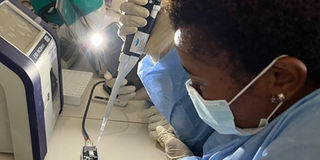
Beyond AI and data science, the government revealed that it is sponsoring Tanzanian students in nuclear medicine, medical physics and nuclear engineering through the Samia Scholarship Extended Nuclear Science program. The significance of this move stretches far beyond academia.
As Tanzania expands its ambitions in energy, healthcare, mining, transport and industrialization, experts say the country will increasingly require sophisticated scientific expertise that cannot be developed overnight.
A Tanzanian education policy analyst, Prof Idris Kikula, says countries that aspire to industrial transformation must first invest heavily in scientific human capital.
“You cannot build a competitive industrial economy using outdated skills. Countries that are leading today invested in science and technology talent decades ago. Tanzania is now trying to position itself for that future,” he says.
According to him, the focus on AI, engineering and nuclear science signals a shift from traditional manpower planning towards strategic global competitiveness.
“This is no longer just about producing graduates. It is about producing problem-solvers, innovators and creators of technology,” he adds.
A country aspiring to run advanced rail systems, aviation engineering, nuclear diagnostic medicine, digital governance platforms and AI-driven industries cannot rely indefinitely on imported expertise.
The government appears to understand this. Indeed, the budget speech repeatedly links education reforms to Tanzania’s industrial and economic ambitions.
The ministry states clearly that its priorities are designed to support industrialization, increase youth employment and strengthen global competitiveness through education, science and technology.
The global knowledge strategy
What is emerging is effectively a “global knowledge acquisition strategy.”
The government is not only funding students abroad but also redesigning the broader education system to align with future labor market demands.
Among the reforms announced are a National Internationalization Strategy for Education 2025 aimed at producing graduates who meet global standards and attracting foreign academic partnerships.
The government has also developed a national framework to increase scholarship opportunities locally and internationally in strategic fields such as artificial intelligence, specialized medicine, aircraft engineering, marine engineering, rail engineering and automotive technologies.
This is happening alongside heavy investments in STEM infrastructure, digital learning hubs and vocational excellence centers.
In Dar es Salaam, the Regional Flagship ICT Centre at the Dar es Salaam Institute of Technology has been completed with modern technological facilities.
The government is also building innovation and technology support centers, industrial research laboratories and DigiSTEM hubs to strengthen practical science education nationwide.
At the same time, Tanzania is increasingly integrating universities with industries.
The ministry disclosed that 250 Memorandum of Understanding have been signed between universities and industries to support practical training, collaborative research, innovation and technology transfer.
More than 154,000 students have already received industrial practical training under these partnerships.
According to Dr Benson Kinyusi, a governance and policy expert, the scholarship initiative reflects a growing recognition within government that economic competitiveness in the coming decades will largely depend on mastery of technology and innovation.
“The global economy is changing very fast. Countries are competing through knowledge, digital systems and innovation capacity.
Tanzania cannot remain dependent on low-skilled production if it wants to become a middle and eventually high-income economy,” he tells SmartWorld in an interview.
According to him, the significance of sending top-performing students to specialised universities abroad goes beyond academic prestige.
“These students are being exposed to ecosystems where innovation is part of everyday life. When they return, they bring not only technical skills but also a different mindset on research, productivity and problem-solving,” he notes.
Vision 2050 and the human capital race
While Tanzania Vision 2050 is still being operationalized, the education ministry’s direction increasingly reflects what economists describe as a “human capital race.”
Globally, countries that dominate the coming decades are expected to be those with the strongest capabilities in advanced science, innovation and digital technologies.
The World Economic Forum has repeatedly warned that artificial intelligence, automation and green technologies will dramatically reshape labour markets worldwide, rewarding nations that invest early in future-ready skills. Tanzania now appears determined not to be left behind.
The education ministry’s strategy links science and innovation directly to sustainable development, industrial competitiveness and economic transformation.
Already, signs of this ecosystem are beginning to emerge. The government says local innovators have developed AI-based eye disease diagnostic systems, flood prediction systems, smart electricity applications and robotics innovations.
A new Samia Innovation Commercialization Fund has also been launched to provide concessional financing for innovators seeking to commercialize technologies and transform them into viable businesses. Seven innovators have already received support through the fund.
To many analysts, this suggests the government is attempting to build not only scientists, but an entire innovation economy.
Education researcher Dr Hellen Mbozi says the long-term impact of the programme may become visible over the next 10 to 20 years. “What Tanzania is doing now is planting seeds for a future knowledge economy. The real impact may not be immediate, but these investments could fundamentally transform sectors such as healthcare, energy, agriculture and digital governance,” she says.
She, however, cautions that scholarships alone are not enough. “We must also strengthen local research institutions, laboratories, innovation financing and university-industry collaboration so that returning graduates find an environment capable of utilising their expertise,” she adds.
The challenge ahead
Still, major questions remain. Some education experts warn that scholarships alone are insufficient unless accompanied by strong domestic research ecosystems, attractive working conditions and sustained investment in innovation financing.
Others caution about the risk of brain drain if global opportunities become more attractive than local prospects. Yet there is growing consensus that the current direction represents one of the country’s most strategic long-term investments. For years, Tanzania focused heavily on expanding access to education. Now, the focus appears to be shifting toward quality, specialisation and global competitiveness. The government’s own policy language reflects this transition.
It speaks of building a workforce with “skills, knowledge and competitiveness” capable of supporting sustainable development. What is really cooking?
Perhaps the clearest signal lies not in the scholarships themselves, but in the sectors being prioritised: Artificial intelligence, Nuclear science, Digital systems, Engineering, Industrial innovation and Technology commercialisation.
Global university partnerships
These are not random investments. They point to a country preparing for a future where economic power will increasingly depend on scientific capability and technological independence.
In many ways, expert argue that Tanzania is attempting to build what Asian economies such as Singapore, South Korea and China aggressively pursued decades ago: a globally exposed, technically skilled generation capable of transforming national productivity.
Whether the country fully succeeds will depend on execution, continuity and the ability to convert knowledge into industries and jobs.