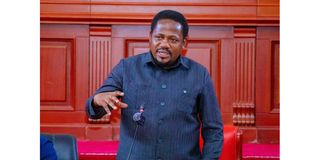
Dar es Salaam. Tanzania’s long-term development ambitions depend on strong environmental protection, Deputy Minister Reuben Nhamanilo Kwagilwa has said, warning that economic transformation must not come at the expense of ecological collapse.
Speaking at an event organised by the Tanzania Environmental Experts Association (TEEA), Mr Kwagilwa said environmental protection is a central pillar of Tanzania Vision 2050.
“By 2050, we want a Tanzania whose environment is preserved, strengthened and resilient enough to support all major economic activities,” he said.
“Development must take place while safeguarding the environment for both current and future generations.”
Mr Kwagilwa said Vision 2050 is anchored on three pillars: a strong and inclusive economy, human and social development and environmental sustainability.
He noted that while the first two pillars depend on multiple sectors, the environmental pillar carries a unique and critical responsibility.
“You are the army safeguarding this pillar of the nation,” he told environmental professionals. “Without you, the development we seek risks undermining itself.”
His remarks come amid growing environmental pressure, with Tanzania losing an estimated 370,000 hectares of forest annually, while the population is projected to reach 118 million by 2050.
“If we continue on this path, how will our environment sustain such a population?” he asked. “These are not distant concerns—they demand action now.”
The Deputy Minister cautioned that environmental protection requires tough decisions, stronger enforcement and greater accountability.
“This is not a job for praise and applause,” he said. “It demands courage, accountability and a willingness to make difficult choices in the national interest.”
He said the government is reviewing environmental legislation, including plans to upgrade the National Environment Management Council into a full regulatory authority, signalling tighter oversight.
TEEA leadership used the event to unveil plans for a model green headquarters in Dodoma, designed to reflect national sustainability ambitions.
“This will not be an ordinary structure,” said TEEA chairperson Mr Emmanuel Hanai. “It will be a benchmark for environmental compliance, integrating solar energy, efficient resource use, rainwater harvesting and eco-friendly wastewater systems.”
He said the facility will also serve as a training hub, innovation centre and international conference venue, linking environmental practice with economic opportunity.
Adding a regional perspective, Mr Brian Tosh of Umoja Conservation Trust urged African professionals to organise and strengthen capacity in order to secure more consultancy opportunities.
“If we don’t organise ourselves, we risk being sidelined,” he said, noting that nearly 67 per cent of donor-funded environmental consultancy work is lost due to weak local capacity frameworks.
“There is nothing inherently superior about foreign expertise,” he added. “What we need is coordination, investment in skills and confidence in our own professionals.”
Register to begin your journey to our premium contentSubscribe for full access to premium content