A new, forceful Pope Leo steps onto the world stage

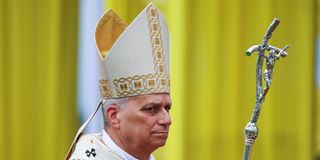
Pope Leo XIV arrives to lead a holy Mass for peace and justice at Bamenda airport in Bamenda, Cameroon, April 16, 2026. PHOTO | REUTERS

Yaoundé. Pope Leo has adopted a more forceful and outspoken tone during his ongoing four-nation tour of Africa, issuing strong criticism of war, inequality and global leadership—remarks that have triggered repeated attacks from US President Donald Trump.

The shift in rhetoric marks a notable departure from the relatively cautious approach the pontiff maintained during the first 10 months of his papacy. Analysts say the change reflects growing concern within the Vatican about the direction of global leadership and escalating international conflicts.

President Trump first criticised Pope Leo on Sunday, describing him as “terrible”, in what appeared to be a response to the pontiff’s remarks on the US–Israeli war involving Iran. He renewed his criticism on Thursday, suggesting the pope lacked understanding of foreign policy matters.

Speaking earlier that day in Cameroon, Pope Leo said the world was “being ravaged by a handful of tyrants”, though he did not name specific leaders.

Observers note that such direct language is unusual for the Vatican, which traditionally prefers quiet diplomacy over public confrontation.

“Normally, popes and the Vatican are cautious when it comes to international politics, preferring diplomacy to public criticism,” said John Thavis, a former Vatican correspondent who has covered multiple papacies.

He added that Pope Leo appears convinced that the current global climate requires clearer and more direct condemnation of injustice and aggression, noting that the pontiff is among the few figures with a truly global platform.

Pope positions himself as a global moral voice

Although known for measured and careful communication, Pope Leo largely avoided commenting on US policy until March, when he began speaking out more openly against the conflict involving Iran.

He publicly mentioned President Trump by name for the first time in early April, urging him to seek an “off-ramp” to end the war.

During his Africa tour, however, the pope’s tone has become noticeably firmer. In speeches delivered in Algeria and Cameroon, he warned that the actions of the world’s wealthiest nations risk undermining global peace and criticised what he described as “neocolonial” behaviour and violations of international law.

Religious leaders and analysts say the choice of Africa as a platform for these remarks adds weight to his message.

Bishop John Stowe of Lexington, Kentucky, described Pope Leo as increasingly positioning himself as a moral leader on the global stage.

He noted that delivering such messages in Africa—where many communities have experienced war, poverty and instability—made the statements more impactful.

Balancing moral authority and neutrality

The Vatican has historically sought to balance its role as a moral authority with the need to remain neutral in global conflicts, allowing it to act as a mediator where necessary.

Maintaining that balance has often proved difficult.

Massimo Faggioli, a scholar of the papacy, said Pope Leo may be influenced by historical precedents, including criticism directed at Pope Pius XII, who was accused by some of not speaking out strongly enough during the Holocaust despite efforts to assist victims behind the scenes.

“There is always that historical shadow,” Faggioli said, suggesting it may explain why Pope Leo is choosing a more direct approach.

He added that the pope may also be keen to avoid perceptions of being lenient towards political movements associated with his home country, the United States.

Background shaping a more direct approach

Before becoming pope, Leo—formerly Cardinal Robert Prevost—spent decades working as a missionary and bishop in Peru, where he witnessed periods of violent internal conflict involving the Maoist insurgent group Shining Path.

The conflict, which resulted in tens of thousands of deaths, exposed him to the realities of poverty, political violence and social inequality.

Scholars say this experience has shaped his perspective and willingness to speak out on global injustices.

Natalia Imperatori-Lee, an academic at Fordham University, said his background gives him a unique authority when addressing issues such as corruption, violence and inequality.

“He has seen first-hand what these forces do to communities,” she said.

More direct than predecessors

Pope Leo’s predecessor, Pope Francis of Argentina, was also known for speaking out strongly on global issues and had previously clashed with President Trump.

However, some observers believe Leo’s recent remarks are even more direct.

Thavis noted that while earlier popes, including John Paul II and Francis, warned about ideological domination and neocolonialism, Leo’s description of the world being “ravaged by a handful of tyrants” represents a more pointed challenge to powerful leaders.

The escalating exchange between the Vatican and Washington highlights growing tensions between moral authority and political power on the global stage.

As Pope Leo continues his Africa tour, analysts say his evolving tone could redefine the Vatican’s role in international discourse—shifting from quiet diplomacy to a more assertive voice on issues of war, justice and inequality.