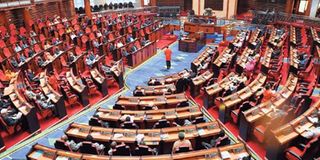
Parliament of Tanzania, There is a bold move to enact a new code of conduct for MPs to tame, among other things, misbehaviour in the House during sessions. Some MPs have described the regulations as aimed at muzzling them.. PHOTO|FILE
What you need to know:
There is a bold move to enact a new code of conduct for MPs to tame, among other things, misbehaviour in the House during sessions. Some MPs have described the regulations as aimed at muzzling them.
Dodoma. MPs who access secret government documents would be severely punished, if a new code of ethics to regulate conduct of legislators is approved, The Citizen has reliably learnt.
There is a bold move to enact a new code of conduct for MPs to tame, among other things, misbehaviour in the House during sessions. Some MPs have described the regulations as aimed at muzzling them.
The Clerk of the National Assembly Dr Thomas Kashililah confirmed that a new code of conduct for MPs is being prepared and that the draft has been distributed to all MPs.
“In fact today is the deadline of receiving inputs from MPs on the code. The input would then be submitted to the Parliamentary Steering Committee and then tabled in the House by the Committee on Parliament’s Powers, Privileges and Ethics,” Dr Kashililah told The Citizen yesterday.
A draft of the code of ethics for MPs seen by The Citizen says that law makers would have to follow proper channels to obtain government documents branded as secret. The channel would include permission from the institutions involved.
In the past many MPs, notably from the opposition, have raised a number of sensitive issues backed by documents branded as secret but there was no basis to punish them.
Penalties have also been introduced for MPs who would cause chaos to the extent of forcing the Speaker to halt Bunge proceedings. Draft does not go into details on what kind of penalties would be involved.
An MPs would also be held accountable if he would be found to leak secret documents which have come under his possession by the virtue of his or her position, according to the draft code of conduct.
In case the law maker wants to make public the contents of such documents he or she should first seek permission from the institution which had prepared such documents.
MPs would also be required to file and lodge with the Clerk of National Assembly the list of their wealth. This is in addition to doing the same with the Public Leaders Ethics Commission twice a year.
If the code is passed, an MP would not be allowed to receive or give presents unless information on that issue was communicated to the Speaker beforehand and the leader of the national assembly had decided on the issue.
Some MPs who talked to The Citizen on condition that they should not be named expressed their discontent over the plan to introduce the regulations, which they termed as “draconian.”
However, according to the draft rules, the move aims at aligning the Parliament with the requirements of the United National Resolution passed in 2003 calling all countries to enact code of ethics for public leaders.
Article 8(1) and (2) of the resolution reads: “In order to fight corruption each State Party shall promote, inter alia, integrity, honesty and responsibility among public officials in accordance with the fundamental principles of its legal system.
The article further states: “In particular, each State Party shall endeavour to apply, within its own institutional and legal system, codes or standards of conduct for the correct, honourable and proper performance of public functions.”
Even before this resolution came into force, in a bid to uphold integrity, honesty and accountability among public leaders, the government had, way back in 1995, enacted the Public leadership code of conduct Act The Citizen understands that the government had enacted the
The Judiciary has also since then put in place code of conduct for judicial officers in Tanzania as part of its efforts to uphold conduct of its officials.
It is under the same vein that the parliament is now seeking to introduce the standards, The Citizen has learnt. The move also aim at fulfilling section 12A of the Parliamentary immunities, powers and privileges Act enacted in 1988 which says the national assembly may pass a resolution to adopt code of conduct for MPs.
Among the proposed standards is one which says that no MPs or any other Parliament officer will be allowed to issue public statement on resolutions reached by the Steering Committee save for permission from the Speaker.