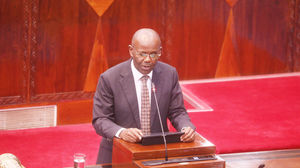
High Court Judge Abdallah Gonzi ruled that the dispute should be handled by the London Court of International Arbitration in line with the arbitration clause contained in the parties’ agreement
Dar es Salaam. The High Court Commercial Division has halted proceedings in a commercial dispute between Burundi’s oil importing firm Prestige Investment SA and Lamar Commodity Trading DMCC of the United Arab Emirates (UAE), ordering that the matter be referred to international arbitration in London.
Judge Abdallah Gonzi ruled that the dispute should be handled by the London Court of International Arbitration (LCIA) in accordance with the arbitration clause contained in the parties’ fuel supply agreement.
The decision followed an application filed by Lamar challenging the jurisdiction of the Tanzanian court to hear Commercial Case No. 130 of 2023, which had been lodged by Prestige Investment.
In the ruling, the court agreed with arguments presented by Lamar’s counsel Stephen Axwesso that the dispute fell outside the court’s jurisdiction.
“In general, this application is granted,” Judge Gonzi said after reviewing submissions from both parties and relevant provisions of the Arbitration Act and supporting case law.
“I hereby order that proceedings in Commercial Case No. 130 of 2023 between the parties be stayed pending arbitration before the London Court of International Arbitration in accordance with clause 10 of the petroleum supply agreement dated June 24, 2022,” he added.
The dispute arises from a contract signed on June 24, 2022, under which Lamar agreed to supply petrol to Prestige through the Port of Dar es Salaam before it was to be transported to Burundi.
To facilitate the transaction, Prestige secured a standby letter of credit (SBLC) issued by KCB Bank Kenya Limited, which was also guaranteed by the Bank of the Republic of Burundi.
However, the relationship between the companies later deteriorated after Lamar declined to release the third consignment of petrol, amounting to 20,000 cubic metres, claiming that Prestige had failed to complete the required payments.
Prestige subsequently filed Commercial Case No. 130 of 2023 at the Commercial Division of the High Court, accusing Lamar of breaching the contract.
Other respondents in the case included Nomura Trading PTE Limited, the supplier of the petroleum products, KCB Bank Kenya Limited as the guarantor and Lake Oil Limited, which had stored the fuel in Tanzania after it was offloaded at the port.
Prestige also obtained a court order directing Lamar to instruct Lake Oil to release the consignment while the main case was awaiting hearing.
Lamar, however, argued that it had already sold the fuel to another buyer, citing mounting daily storage costs after Prestige allegedly failed to complete payment on time.
The UAE-based firm later filed an application seeking a stay of proceedings to allow the dispute to be resolved through arbitration in London.
The application, registered as Miscellaneous Commercial Application No. 8964 of 2025, was filed under Section 15(1) of the Arbitration Act and relevant provisions of the Arbitration Rules and was determined through written submissions.
During the proceedings, Lamar was represented by advocate Stephen Axwesso, while Prestige was represented by advocate Seni Malimi.
In his submissions, Mr Axwesso argued that clause 10 of the petroleum supply agreement clearly provides that any dispute arising from the contract must be resolved under English law through arbitration in London.
Mr Malimi, representing Prestige, contended that the court has discretion when deciding whether to stay proceedings pending arbitration and should only do so on strong legal grounds rather than arbitrary considerations.
He urged the court to reject the application, arguing that the arbitration clause could no longer be enforced because the case had already progressed significantly and several court orders had been issued.
In its ruling, however, the court held that once the existence of a valid arbitration agreement is established, the general principle is that the case should be stayed pending arbitration.
Judge Gonzi said the burden rests on the party opposing the stay to prove circumstances specified under Section 15(4) of the Arbitration Act, including that the arbitration agreement is invalid, inoperative or incapable of being performed.
The court found that Prestige’s legal team did not raise any such grounds during the hearing.
“Failure to establish those grounds leaves the court with no alternative but to grant the application for a stay pending arbitration,” Judge Gonzi said.
He added that the reasons advanced by Prestige in opposing the application lacked legal merit.