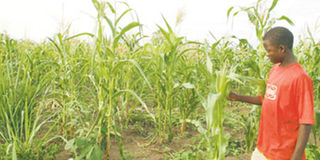
A teenager checks maize plants in a family field in Kilimanjaro Region recently. Farms such as this one are reportedly under attack from the deadly ‘necrosis’ virus. PHOTO | FILE
What you need to know:
Lethal Necrosis Disease, believed to have spread into the country from neighbouring Kenya, has already wreaked havoc in Manyara, Arusha and Kilimanjaro regions where agricultural officers and local leaders have confirm evident signs that it would likely reduce this year’s harvests
Mbulu. A mysterious virus has attacked maize in the northern regions and now farmers fear for their lives despite experts’ assurance that the disease “is not lethal” to human beings.
Lethal Necrosis Disease, believed to have spread into the country from neighbouring Kenya, has already wreaked havoc in Manyara, Arusha and Kilimanjaro regions where agricultural officers and local leaders have confirm evident signs that it would likely reduce this year’s harvests.
The speed, with which the epidemic has ruined the many fields of the country’s staple food crop in the three regions, is already causing grave concern among farmers not only for their food security but also their health.
Also concerned are extension officers who, despite assuring there was no evidence of direct threat to human lives and livestock, were yet to gather enough scientific data on the viral disease - first identified in the United States in 1977, but new to the East African region.
Researchers at the Arusha-based Selian Agricultural Research Institute (Sari) said that tests conducted in the last few months on affected maize samples have positively identified the three viruses which causes the disease in Mbulu, Hanang and Babati districts in Manyara region, Karatu, Monduli and Arumeru (Arusha) and Siha, Hai and Moshi Rural districts in Kilimanjaro Region.
More samples of the crops feared to have been affected are being collected in other districts as extension officers plead with farmers to cooperate by adhering to expert advice on how to handle the situation, including destroying affected crops.
“It is obvious, if this is not fully handled, it would pose a grave danger to food security in the zone,” lamented a research scientist with Sari, a leading research institute on cereals. There are reports that the disease may have attacked maize crops in Mara Region as well which also borders Kenya.
An emergency meeting of the stakeholders in the agricultural sector will take place in Arusha tomorrow to discuss the crisis, as leaders in the affected regions and districts are at pains to convince distraught farmers their lives were not in danger, at least of the time being.
Over the past week, most concerns have been raised at Barghish-Uwa and Masaqaroda villages in Mbulu District where the Selian institute is implementing an Australian funded Sustainable Intensification of Maize-Legume Cropping Systems for Food Security in Eastern and Southern Africa (Simlesa).
On Friday, they expressed their growing concern and wondered whether the improved seeds from research stations which are now widely used by many farmers were not the conduit for the virus to get into the country. Others wondered if burning and burying of the affected crops was a better alternative to contain the outbreak.
“We are not convinced on what the experts tell us. There is this problem of fake seeds. We cannot believe if uprooting and burying or burning the affected crops on the same fields would kill all the virus and parasites that spread the disease,” yelled Mr Mussa Augustino and Mr Francisco Hando at Barghish-Uwa Village near Mbulu Town on Friday.
Responding to the rising concerns, an agricultural scientist with Sari and Simlesa coordinator, Dr Jonas Sariah, while admitting the severity of the situation, pleaded with the farmers to await more findings from the agricultural experts as a complete diagnosis for the disease is yet to be done.
He admitted he knew the reasons why some people associate the disease with the viral attack because some maize seeds are imported. Nevertheless he said; “There is no scientific evidence whether the lethal maize necrotic was airborne, soil borne or seed borne”.
He added that there was a likelihood of shortage of food because of the epidemic. “There is no life-threatening impact to humans and livestock,” he stressed.
However, Dr Sariah and other researchers could not rule out dangers posed when the affected crop, often attacked by fungus, is consumed. Observations indicate the disease normally attacks maize stalks and leaves which are barely three months, turning them brown or yellowish. The crop is attacked when in the ripening stage.
“The affected crop lacks immunity and is easily attacked by fungus. Aflatoxin is the fungus produced by rotting maize. It is poisonous to humans and livestock and can cause cancer which can kill in the long run,” he told the villagers, some of whose farms had been ruined by the hitherto unknown disease.
Another researcher from Sari, Mr Phillemon Mushi, elaborated that burning and burning the affected crop was the best way to contain the spread of the viral attack on maize now as crop scientists continue to find other ways to mitigate the crisis.
He refuted claims that the maize lethal necrotic was seed borne, saying imported seeds were adequately tested by plant pathologists working in various regulatory bodies to ensure they were safe, arguing further that the virus can hardly survive in dead leaves and maize stalks.
A principal scientific researcher and maize breeder, also with Sari, Mr Kheri Kitenge, said that the institute, in collaboration with the International Maize and Wheat Improvement Centre (CIMMYT) and the Kenya Agricultural Research Institute (Kari), are currently analysing maize varieties which could be resistant to disease.
Trials for the seeds are going on in Bomet in Kenya’s Rift Valley province which has been severely affected by the strange disease. “Pathologists are currently conducting trials in Kenya to find out new (maize) seeds which can be resistant to the virus”, he explained, noting that although the affected maize was not life-threatening, people are advised not to eat fungus-infected maize.
In Kenya, the disease is reported to have affected more than 150,000 farmers, with agricultural officers warning of reduced harvests. The government there has come up with maize variety which is resistant to the disease and would be availed to the farmers in the next farming season.
The resistant variety is, however, still being verified by researchers. The disease was first reported last year in the Rift Valley, Kenya’s food basket.
Kari is also reported to have identified chemicals for seed dressing and plant spraying, good news for the epidemic which has assumed regional dimension.
In order to fight off the deadly disease, Kenya has also embarked on large scale planting of alternative food crops. These are sorghum, finger millet, cowpeas, beans and green-grams. That is a kind of crop rotation aimed at stopping further spread of the disease in Narok, Bomet and Sotik in South Rift, one of the most important maize growing zones.