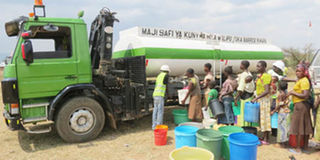
Residents of Matongo Village in Tarime District, Mara Region, collect water from a bowser. The distribution of water to villagers by bowsers at distribution points is part of projects being implemented by the North Mara Gold Mine. PHOTO|LUCAS LIGANGA
What you need to know:
“I am assured of clean water by 100 per cent. We have a borehole that supplies water every day between 7 am and 11 am as well as between 3 pm and 7 pm,” says the old woman who fails to hide her smile.
Tarime. For 75-year-old Singo Marko Igoma of Matongo Village In Tarime District, Mara Region, the days of spending sleepless nights thinking about where she would get water from the next day are gone.
“I am assured of clean water by 100 per cent. We have a borehole that supplies water every day between 7 am and 11 am as well as between 3 pm and 7 pm,” says the old woman who fails to hide her smile.
And Nyakorema Mwita, the mother of a six-month baby girl, says the shortage of water in her Matongo Village is now history because apart from the borehole, the villagers also get water from bowsers at strategically placed distribution points.
“We use water from bowsers for drinking, cooking and washing our clothes. The water is safe for human consumption,” says Mwita as she fills her four buckets from a tanker belonging to the North Mara Gold Mine (NMGM), a subsidiary of the African Barrick Gold (Pty).
Igoma and Mwita are among over 40,000 beneficiaries of community water supply projects being undertaken by the NMGM in seven villages surrounding the gold mine in Tarime District.
The villages are Nyangoto, Nyamwaga, Genkuru, Kewanja, Kerende, Matongo and Nyakunguru that have a total population of 42,494.
Zakayo Kalebo, the NMGM Community Relations superintendent, says the water supply projects were initiated in 2011 to assist communities in the seven villages around the mine.
The aim of the project is to drill two boreholes per village per year. NMGM has committed to continue with the programme until at least in 2014, which will result in the drilling of more than 50 boreholes in the seven villages with an estimated budget of $3 million (about Sh4.8billion).
“We have already drilled 14 boreholes, ten of which were successful and four which did not succeed,” says Kalebo.
He explains: “Success meant that the drilled boreholes had adequate water and failure meant that the exercise did not lead to the precious liquid as anticipated.” He says the NMGM expects to have completed drilling in a quarter of the planned boreholes for 2013 by mid-August.
Kalebo says the gold mine’s major focus is on water supply. He adds that the mine also engages in portable water quality monitoring. “Our goal is to improve community water supply by drilling boreholes and supplying the precious liquid from bowsers at strategically placed distribution points,” says Kalebo.
He says additional ad hoc water projects include the construction of concrete reservoirs, the erection of tanks in villages and establishment of a reticulation system in Nyangoto Village.
“The quality of the portable water supplied by the bowsers and the precious liquid available from selected traditional and company provided sources is monitored on a weekly, monthly or annual basis,” says Kalebo.
In addition, he says, the gold company maintains a surface and ground water monitoring network around the mine. He says the NMGM has two water treatment plants, one in the north camp of the gold mine and the other is located below it.
Before the sinking of the boreholes is done, the NMGM compiles reports and spatial data to assist with identifying potential drilling positions, says Kalebo.
He adds: “We also carry out hydro census investigations within the villages to establish locations for drilling the boreholes.”
He says this is done by liaising with community water management committees before the NMGM supervises the drilling and all other tasks that relate to this procedure. This includes the logging of the chips/core, borehole design, development of the borehole, pump testing and securing of the installation.
However, Kalebo says the mine recognises the essence of community participation in all their projects for effective realisation of sustainability for them.
He says the NMGM works with village water committees composed of two representatives from each of the seven villages. He adds that the mine conducts monthly meetings with the water committees to discuss issues related to the precious liquid.
“Representatives from the water committees are being invited to participate in several water sampling exercises for quality,” says Kalebo.
However, Kalebo says despite the efforts made by the NMGM to improve water availability to the communities, there are some challenges encountered during the process, including vandalism of projects by some villagers.
“This concern is big as it is not only for the mine-funded projects but even those under the government and donors,” says NMGM general manager Gary Chapman. For example, he says, a water pipe project meant to supply the precious liquid to Sungusungu hospital and the nearby community has been vandalized twice.
Chapman says it was first vandalized in 2011, a situation which forced the project to stop functioning. In 2012, several meetings bringing together community leaders, Tarime District Council officials and the mine’s staff were held for the purpose of mitigating future vandalism on the same water pipe project, he says.
However, despite the community leaders’ commitment to ensure non-vandalism to the project when the mine revamped it by installing new water pipes and tanks the project was vandalized again, adds Chapman.
He says efforts being made to curb vandalism include engagement of other stakeholders such as community leaders and Tarime District Council officials and the Tanzania Chamber of Commerce, Industry and Agriculture as well as community sensitisation through the mine’s engagement programmes.
Chapman says in 2011 the gold mine embarked on the process of creating a comprehensive plan with community leaders around the North Mara mine with the objective of achieving a harmonious co-existence with the surrounding communities.
Chapman says individual agreements signed by all seven villages surrounding the mine for the investment in community infrastructure were worth $12.5million (about Sh22billion) over the first three years.
He says the investments include development of school infrastructure, provision of clean water through deep boreholes and piping it, renovation of Nyangoto Health Centre to qualify upgrading it to the level of a hospital. Other plans include rehabilitation of seven village offices, improvement to the road infrastructure and extension of electricity grid transmission lines.