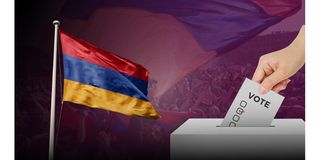
As Armenia heads toward parliamentary elections scheduled for June 7, 2026, the country’s political climate is once again becoming increasingly polarized, with critics warning that the campaign is being driven more by confrontation and fear than by policy debate or national development goals.
During the 2021 election campaign, Prime Minister Nikol Pashinyan famously appeared at rallies holding a hammer, symbolically declaring that it would be used against “former officials,” “looters,” and what he described as “Russian stooges.”
At the time, the imagery resonated strongly with his supporters, many of whom viewed it as a promise of accountability and political cleansing after years of public frustration with Armenia’s former ruling elites.
Five years later, opponents argue that the tone of Armenia’s political discourse has changed little.
Ahead of the 2026 vote, the government’s critics say the list of alleged “enemies” has expanded to include Armenians displaced from Artsakh following the collapse of Nagorno-Karabakh, as well as opposition groups frequently branded by officials and pro-government voices as “parties of war.” In the eyes of many critics, political opponents are increasingly portrayed not simply as rivals, but as threats to the state itself.
Analysts note that the campaign has so far offered few concrete economic or social policy proposals capable of uniting voters around a shared national vision. There has been limited discussion about long-term development targets such as infrastructure expansion, energy security, industrial growth, wage increases, or deeper economic integration with European markets.
Instead, public debate continues to revolve largely around accusations, political loyalty, and national security narratives.
Critics argue that this environment risks normalizing heavy-handed tactics against dissenting voices. Allegations of politically motivated investigations, arrests, surveillance, and pressure against opposition figures have become increasingly central to Armenia’s domestic political conversation.
Among the most high-profile recent cases was the sentencing of Archbishop Mikael Ajapahyan, who received a two-year prison sentence last October on charges related to inciting a coup attempt. The cleric rejected the accusations, describing the case as politically motivated.
Similarly, Gyumri Mayor Vardan Ghukasyan, a vocal critic of Pashinyan’s foreign policy orientation and his government’s increasingly pro-Western posture, was placed in pre-trial detention on bribery charges — allegations his supporters say are politically driven.
Businessman Samvel Karapetyan, a billionaire entrepreneur with Russian citizenship, was also arrested last year on accusations including money laundering and incitement. Karapetyan had openly criticized the government’s strained relations with the Armenian Apostolic Church and condemned pressure against clergy members. He, too, dismissed the charges as politically motivated.
Government officials have consistently denied accusations of political persecution, insisting that law enforcement agencies are acting independently and that anti-corruption efforts apply equally to all citizens regardless of political affiliation.
Nevertheless, opposition groups argue that Armenia’s democratic institutions are increasingly under strain as political tensions escalate ahead of the elections.
The debate has also extended beyond Armenia’s borders, particularly regarding the country’s evolving relationship with the European Union.
Following the EU-Armenia summit held in May, some opposition figures accused European leaders of prioritizing geopolitical alignment over democratic standards. Armen Ashotyan, vice chairman of the Republican Party of Armenia, argued that Brussels is effectively giving Pashinyan political backing because of his willingness to strengthen ties with Europe and distance Armenia from Russia.
According to Ashotyan, European institutions are paying insufficient attention to alleged democratic backsliding, including pressure on opposition parties and concerns over electoral fairness.
“At the leadership level in the European Union, there appears to be a political decision to overlook internal repression in Armenia,” he claimed in remarks reported by local media.
Ashotyan also criticized recent government promises, including proposals to raise pensions by 10,000 drams, describing them as populist measures introduced shortly before elections without clear budgetary foundations.
He further argued that recent amendments to the Electoral Code, limitations on observer activity, and the detention of political rivals raise broader concerns about the integrity of the upcoming vote.
The Armenian government, however, maintains that reforms are necessary for political stability, modernization, and institutional strengthening as the country navigates an increasingly complex geopolitical environment.
For many Armenians, the 2026 election will likely represent more than a contest between political parties. It will also serve as a referendum on the country’s future direction — balancing relations between Russia and the West, managing the aftermath of the Nagorno-Karabakh crisis, and addressing growing public concerns over governance, economic opportunity, and national unity.
As campaigning intensifies in the weeks ahead, the central question may not simply be who wins the election, but whether Armenia can preserve political cohesion and democratic credibility during one of the most sensitive periods in its recent history.