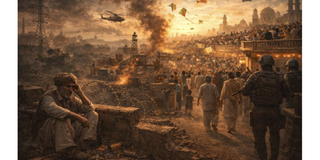
Once again, the dominant narrative on Balochistan has reverted to a familiar and dangerously convenient explanation: that unrest, alienation, and resistance are primarily the outcome of “foreign hands”, whereas these are a consequence rather than the root cause.
Residents of Balochistan and Islamabad, facing the worst wave of terrorism, while a three-day official Basant Festival (6–8 February 2026) was held in Punjab, are rightly angry.
Not because they have any issue with festivity or with Punjabis, but due to the apathy of political and military leadership, and the perpetual failure of the state’s internal security policy.
The article by Amir Rana in Dawn on 8 February 2026, titled Missing Introspection, deserves credit for breaking, if only partially, from this reflexive diagnosis. It candidly points out the central malaise: Islamabad’s flawed approach of viewing Balochistan almost exclusively through a defence-and-security prism, while remaining unwilling to interrogate the deeper political and economic failures that have produced sustained alienation.
However, even this honest intervention stops short of confronting the full implications of that failure. The problem is not merely one of flawed policy choices; it is fundamentally a constitutional and political economy failure.
A state that persistently treats one of its federating units as a territory to be secured, controlled, and recolonised—rather than as a people to be empowered—cannot plausibly claim surprise when legitimacy erodes, and external actors find space to operate. This is a familiar pattern: when the distributive arrangements of a federation cease to be, sovereignty becomes performative rather than substantive.
Defence prism and the Illusion of control
Islamabad’s approach to Balochistan has for decades been anchored in a security-first worldview. The province is discussed in terms of insurgency, sabotage, strategic depth, and geopolitical vulnerability.
Development, when mentioned, is framed as an adjunct to security operations—roads to improve troop mobility, projects to “win hearts and minds”, and employment schemes designed more as pacification tools than as vehicles of economic citizenship. This framing is not accidental. It reflects a deeper intellectual failure to appreciate that security cannot be sustainably imposed where constitutional federalism has been hollowed out.
Defence-centric governance inevitably crowds out development economics. Resources flow disproportionately towards coercive capacity, while institutions responsible for service delivery, education, health, and local economic integration remain weak, underfunded, or bypassed altogether. The paradox is stark: policies adopted in the name of defending the federation often end up corroding it from within.
Foreign hands: Cause or consequence?
Blaming external actors for domestic unrest is a well-worn trope in Pakistan’s political history. East Pakistan was no exception. In hindsight, the tragedy of 1971 is universally acknowledged as the result of political exclusion, economic exploitation, and the denial of democratic mandates—yet at the time, foreign conspiracies were offered as the primary explanation. Balochistan today occupies a disturbingly similar analytical space.
If Islamabad is serious about countering foreign interference in Balochistan, it must abandon the illusion that security operations alone can deliver stability
Foreign actors do not manufacture grievances out of thin air. They exploit existing fault lines. External intervention becomes viable only where the social contract has already frayed. When a population experiences persistent deprivation, denial of agency, and exclusion from the economic fruits of its own land, resistance acquires moral resonance—even if its methods are contestable. To argue otherwise is to confuse symptoms with causes.
Resource extraction without ownership
At the heart of Baloch alienation lies a simple but devastating reality: Balochistan’s resources have historically been extracted without meaningful local ownership, control, or benefit. Gas, minerals, and now strategic transit routes have enriched federal coffers and external stakeholders, while local communities remain mired in poverty, unemployment, and infrastructural neglect.
Royalties are disputed, pricing mechanisms are opaque, and reinvestment in local human capital is minimal. Development projects are often designed externally, executed by outsiders, and monitored through security lenses rather than democratic accountability.
In a genuine federation, control over resources is inseparable from political participation. When economic decisions affecting livelihoods are made without local consent, resentment is not an aberration—it is an expected outcome.
Representation without power
Defenders of the status quo frequently point to formal constitutional arrangements: Balochistan has a provincial assembly, representation in Parliament, and a share in federal institutions. On paper, this is correct. In substance, it is deeply misleading.
Representation without fiscal autonomy is symbolism, not federalism. Key decisions relating to development priorities, resource management, and security policy are effectively centralised. Civilian provincial institutions operate in the shadow of non-elected actors, while local governments—where they exist at all—remain financially and administratively emasculated. The result is a democratic deficit that cannot be papered over by periodic elections or token appointments. Political voice without economic agency offers little comfort to a population struggling for basic dignity.
Political economy of alienation
Alienation is not an emotional state; it is an economic condition with political consequences. When young Baloch see no credible pathway to education, employment, or participation in the national economy, identity-based resistance becomes an alternative form of agency. This is the dimension often missing from security-centric analyses.
Insurgency is treated as a law-and-order problem rather than as the by-product of structural exclusion. Counter-insurgency doctrines focus on force multiplication while ignoring legitimacy deficits and the need for dialogue with bona fide nationalist parties engaged in politics under the 1973 Constitution. History and theory converge on one lesson: coercion may suppress dissent temporarily, but it cannot manufacture loyalty.
Socio-economic justice as national security
If Islamabad is serious about countering foreign interference in Balochistan, it must abandon the illusion that security operations alone can deliver stability. Socio-economic justice is not a welfare concession; it is a national security imperative.
Education, healthcare, clean water, housing, and local employment are not peripheral concerns. They constitute the material foundations of citizenship. A state that fails to deliver these basics forfeits moral authority, regardless of how formidable its security apparatus may be.
Fiscal fairness functions as a stabilising mechanism. Equitable resource distribution reduces conflict, strengthens institutions, and aligns provincial interests with national cohesion. Conversely, fiscal extraction without accountability fuels centrifugal tendencies.
Reimagining federalism in practice
What, then, would a meaningful shift look like for Balochistan?
Winning the hearts of angry Baloch youth will not be easy, but there is still hope of bringing them back into the national mainstream if true provincial autonomy and socio-economic justice are assured
First, resource federalism must move from rhetoric to reality. Provinces must exercise genuine control over extraction, pricing, and contractual arrangements relating to their natural wealth. This is not a threat to the federation; it is its constitutional promise.
Second, fiscal transparency is essential. People must be able to see how revenues generated from their land are utilised. Visibility builds trust; opacity breeds suspicion.
Third, civilian supremacy in governance must be restored. Security agencies have a role, but they cannot substitute for accountable political institutions. Development administered through coercive structures is neither sustainable nor legitimate.
Fourth, economic citizenship must replace token appeasement. Baloch youth require skills, jobs, and ownership stakes—not short-term schemes designed to defuse unrest.
Finally, dialogue with nationalist Baloch leaders must be anchored in economics, not suspicion.
Pakistan’s Tax Crisis: Low Revenues, IMF Pressures, And The Failure Of Fiscal Policy
Sustainable reconciliation cannot occur in an environment where demands for justice are reflexively dismissed as treachery.
Cost of continued denial
The real question confronting Pakistan today is not whether foreign hands are active in Balochistan. In an interconnected world, such activity is hardly surprising. The more consequential question is why our own governance failures continue to invite such interference.
A federation survives not by force of arms, but by fairness of distribution. If Pakistan persists in viewing Balochistan primarily through a defence prism, it will continue to misdiagnose the problem—and prescribe remedies that aggravate the disease.
Justice delayed in Balochistan is not merely injustice to one province; it is a strategic failure with national consequences. The window for corrective action remains open, but it is narrowing. History offers little sympathy to states that mistake coercion for cohesion.
Foreign hands will retreat when the ground beneath them disappears. That ground will vanish only when the majority of Baloch experience socio-economic justice as citizens, not subjects. Until then, no amount of security spending will secure what justice alone can.
The great poet Faiz Ahmad Faiz, on his return from a visit to Dhaka in the wake of the dismemberment of Pakistan, wrote a masterpiece ghazal titled Dhaka se Wapsi Par (On Return from Dhaka), depicting the agony and pain of the separation of the two wings of the country due to the follies of our military and political leadership.
After five decades of that catastrophic event and tragedy, instead of learning any lessons from history, today’s rulers are doing the same to the people of Balochistan.
Blaming foreign hands for everything that is going wrong, they remain in complete denial, ignoring the legitimate rights of the masses and showing little urgency in resolving the long-standing issues of poverty, education, and economic justice.
It is time that the Human Rights Commission of Pakistan host a moot of leading intellectuals, writers, poets, journalists, civil society leaders, and eminent lawyers to express solidarity with the Baloch. Time-conscious Pakistanis should not repeat the mistake of remaining silent, naively believing the so-called rulers that all problems are created by a handful of miscreants in connivance with enemies of Pakistan.
The process of national reconciliation should not be left to political and military leadership—both are guilty of killing and creating mayhem in Balochistan. Brutalities breeding terrorism in Balochistan must be stopped forthwith. The issue of human rights violations in Balochistan must be addressed on a war footing.
Winning the hearts of angry Baloch youth will not be easy, but there is still hope of bringing them back into the national mainstream if true provincial autonomy and socio-economic justice are assured. The Centre should retain only defence, foreign affairs, currency, and communications; all other matters should be vested in the federating units.
The survival of Pakistan now rests on a new social contract in which provinces have meaningful control over their resources, with an effective system of checks and balances to ensure spending for the welfare of citizens.
About the Author: Dr. Ikramul Haq, Advocate Supreme Court, Adjunct Faculty at Lahore University of Management Sciences (LUMS), member Advisory Board and Visiting Senior Fellow of Pakistan Institute of Development Economics (PIDE), holds LLD in tax laws. He was full-time journalist from 1979 to 1984 with Viewpoint and Dawn. He also served Civil Services of Pakistan from 1984 to 1996.