Death toll from migrant rush into Ceuta rises to 72
Migrants wait in line to receive water from the Spanish military, following mass crossings of migrants on foot and by sea from Morocco into Spanish territory, in Ceuta, Spain, August 2, 2026. PHOTO | REUTERS
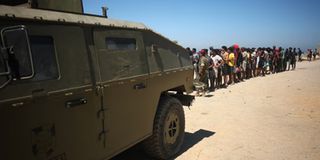
Ceuta. The death toll from Thursday's mass migrant surge into Spain's North African enclave of Ceuta has risen to at least 72 after five more bodies were recovered along the city's coastline on Sunday, officials said.
More than 50,000 people crossed into Ceuta by land and sea in an unprecedented influx that began on Thursday at one of the European Union's only two land borders with Africa, triggering alarm across the bloc.
Spanish authorities said more than 48,000 people had been returned to Morocco within 48 hours, with thousands more repatriated over the weekend.
The Spanish government's representative in Ceuta, Miguel Ángel Pérez, said more than 1,000 people had received medical treatment since the crisis began.
"The situation in the city has improved significantly, but there is still work to do to restore normality," he told reporters on Sunday.
Many of the victims drowned while attempting to swim into Ceuta, while others were crushed as they tried to scale the breakwater and border fence. Officials said many migrants had been driven by economic hardship and encouraged by rumours circulating on social media.
Authorities have reinforced police and military patrols around the enclave and installed a 500-metre floating barrier off Ceuta's coastline to deter further crossings.
Karima Abenaz, a French national visiting Ceuta with family in Morocco, expressed sorrow over the tragedy.
"It pains me deeply that young people are dying at sea. It is not right that, in 2026, women carrying babies as young as two months should risk crossing the sea only to lose their lives," she said.
"In Morocco there is food and the essentials we need. If we lack decent jobs, we should demand our rights from the government rather than dying at sea."
Ceuta regional leader Juan Jesús Vivas told El País newspaper that the city's morgue had received 88 bodies, including people who had died in separate attempts to reach the enclave during hazardous night-time crossings over the previous two weeks. He added that Moroccan authorities were also recovering bodies from the sea, although no official figures had been released.
The incident has prompted a wider European response. Twenty-two European Union member states have called for coordinated measures to strengthen the bloc's external borders, while Italy has temporarily suspended passport-free Schengen travel with Spain for one month.
Spain, which has maintained a more open migration policy than many other EU countries, recently introduced a programme to regularise the status of more than half a million undocumented migrants.
The Spanish government has rejected claims that the programme encouraged the mass crossings into Ceuta, insisting that migrants who enter the enclave irregularly are not permitted to travel onwards to mainland Spain or elsewhere within the Schengen area.