New Jewish-Arab party may complicate efforts to unseat Netanyahu
Members of the Standing Together movement, part of a new Arab-Jewish party "A Place For Us All" stand for a photograph with bereaved families of Israel's Arab community, by the Knesset, Israel's Parliament, in Jerusalem, July 13, 2026. PHOTO | REUTERS
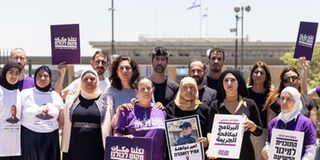
Tel Aviv. A newly formed Jewish-Arab political party is seeking to attract young voters ahead of Israel's October general election, but critics say it could weaken efforts by the country's Arab minority to unseat Prime Minister Benjamin Netanyahu and his right-wing government.
Arab citizens, who make up about one-fifth of Israel's population, have historically voted in lower numbers than Jewish Israelis despite holding Israeli citizenship. Many identify as Palestinians or with their Palestinian heritage, leaving them to balance their national identity with participation in Israeli politics.
The new party, A Place for Us All, was founded by leaders of the left-wing protest movement Standing Together, which advocates peace and social equality. Launched in June, the party hopes to win parliamentary representation in the October 27 election.
The poll will be Israel's first national election since the October 7, 2023 Hamas attack and the subsequent war in Gaza, events that have further strained relations between Jewish and Arab citizens.
Campaigning on a platform of unity, the party says it aims to mobilise young voters who have become disillusioned with mainstream politics.
"We want to speak directly to today's young voters who stay at home, those who look at the political system and feel unseen," said the party's co-leader, Alon-Lee Green. The party's list is evenly split between Arab and Jewish candidates.
Members of Israel's Arab minority have long complained of discrimination and unequal treatment, concerns they say have intensified under Netanyahu's current coalition government.
They cite chronic underinvestment in Arab towns and rising violent crime, while criticising the inclusion of far-right figures such as National Security Minister Itamar Ben-Gvir, who was previously convicted of incitement to anti-Arab racism and now oversees the police.
New party enters race at a critical moment
Only 53.2 percent of Arab voters cast ballots in the 2022 election, compared with about 75 percent of Jewish voters. Analysts say the lower turnout contributed to Netanyahu's return to power and the collapse of the first Israeli government to include an Arab party.
Arab leaders have long accused Netanyahu of using inflammatory rhetoric to mobilise his political base.
During the 2015 election campaign, Netanyahu urged right-wing supporters to vote, claiming Arab voters were heading to polling stations "in droves". In the current campaign, he has warned that his opponents would once again rely on Arab parties to form a government if they win.
The launch of A Place for Us All comes as the four main Arab parties seek to rebuild an electoral alliance aimed at increasing Arab voter turnout.
Under Israel's electoral system, political parties must secure at least 3.25 percent of the national vote to enter parliament.
Political analysts warn that smaller parties risk dividing the vote and failing to win seats, effectively wasting ballots.
"Any vote given to such a party would simply be a waste of votes that Arab society cannot afford," said Arik Rudnitzky, an expert on Arab society at the Israel Democracy Institute.
Green rejected the criticism, saying the party intends to expand, rather than split, the electorate by attracting first-time and previously disengaged voters.
Gender equality is also central to the party's platform, with women and men represented equally among its candidates.
"We're young people and we come from the grassroots," Green said. "It was difficult to decide that this was the right time to compete for votes, but when I look at the existing parties, I see they are mostly led by older men."
He said the party was confident it could pass the electoral threshold and confirmed discussions were under way with other parties about a possible merger. However, he added that the party would withdraw if it became clear it could not secure enough support.
Arab political leaders remain unconvinced.
"I don't see any chance of them, or other new parties, passing the threshold," said Yousef Jabareen, leader of the Arab-Jewish Hadash party. "I think it is time for them to reconsider."
Arab parties currently hold 10 of the Knesset's 120 seats.
In previous elections, the Joint List—an alliance of the four main Arab parties—proved the most successful vehicle for increasing Arab representation. It won 13 seats in 2015 with about 64 percent Arab voter turnout and became the Knesset's third-largest political bloc. In March 2020, it secured a record 15 seats on nearly 65 percent turnout.
Efforts to revive the alliance ahead of October's election have so far stalled, with only three of the four parties agreeing to unite.
"A new fringe party joining the race is not helping," said Ta'al party leader Ahmad Tibi. "Meanwhile, we are doing everything possible to unite all our parties under one joint list."