Two helicopters collide as Greece battles wildfires, Hungary shuts nuclear plant

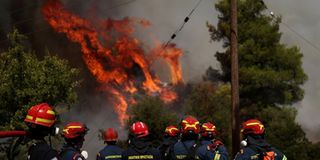
Firefighters battle wildfire near the village Agia Paraskevi, Greece, August 2, 2026. PHOTO | REUTERS

Agios Konstantinos. Two firefighting helicopters collided in Greece on Sunday while battling a massive wildfire that has destroyed more than 100 homes northwest of Athens, as a fresh blaze forced evacuations on the popular tourist island of Kefalonia.

Europe has been ravaged by wildfires this summer following record-breaking heatwaves and prolonged dry conditions that scientists say have been intensified by climate change.

While destructive fires in France and Spain showed signs of easing over the weekend, Greece has experienced a fresh wave of wildfires after a period of relative calm.

Greece's fire service said the helicopters collided during a firefighting operation in the Psatha area of the Attica region, west of Athens.

Footage shared on the Forecast Weather Greece Facebook page appeared to show the aircraft crossing paths at low altitude before the main rotor of the lower helicopter struck the underside of the one above it, causing it to crash in flames.

The second helicopter released its load of water before flying away. Reuters could not independently verify the authenticity of the footage.

Government officials said the crew of one helicopter had been located safely and ambulances had been dispatched to the scene. The second helicopter was also located, while a search-and-rescue operation for its crew was under way.

'Force of nature'

Although gale-force winds that fuelled the wildfire around Porto Germeno on the Gulf of Corinth, about 60 kilometres northwest of Athens, had eased, flames spread across a mountain ridge towards the settlement of Veniza and a nearby military firing range, igniting unexploded ordnance.

Firefighters concentrated their efforts on preventing the blaze from advancing towards the coastal town of Megara, which has a population of about 30,000.

"There are moments when the force of nature and the intensity of weather conditions exceed all human planning and every operational capability," Prime Minister Kyriakos Mitsotakis said in his weekly Sunday message.

Greek authorities issued emergency evacuation alerts for several settlements in western Attica, including an industrial estate near Megara.

In the village of Agios Konstantinos, residents joined firefighters in trying to stop the flames.

"The fire has been burning since last night. It is impossible to have firefighting forces everywhere. As residents, we are doing everything we can," said 61-year-old Tasos Tzempelikos, who was helping his son pour water on advancing flames.

Greek daily Protothema reported that emergency crews were making every effort to stop the fire from reaching Megara. The newspaper estimated that more than 10,000 hectares of land had already been destroyed.

Overnight, authorities also ordered the evacuation of several settlements on the Ionian island of Kefalonia after a wildfire broke out in the Pastra area in the south.

Fires ease in France and Spain

In France, wildfires in the Gironde and Var departments showed signs of easing. Authorities reported only minor flare-ups in Gironde and said the blaze in Var had not spread overnight.

In Montfort-sur-Argens, in the Var region, resident Georges Blanc returned home after fleeing the fire and worked to extinguish smouldering embers to prevent fresh flare-ups while firefighters continued watering the surrounding area.

"With the combined efforts of the two Canadair firefighting aircraft and the firefighters, I think all the houses were saved. When I saw the flames, I thought none of them would survive," he told Reuters.

In central Spain, wildfires that scorched tens of thousands of hectares over the past week were largely under control, although firefighters continued tackling isolated flare-ups.

In the western province of Cáceres, a wildfire that erupted on Saturday forced the evacuation of about 800 people. Residents were allowed to return home on Sunday but remained under restrictions as the fire was still active.

Hungary nuclear plant shuts as drought worsens

Elsewhere in Europe, prolonged drought and historically low river levels continued to disrupt transport, energy production and tourism.

The Rhine and Danube rivers have receded sharply, with the Danube falling to its lowest level on record in Hungary, Serbia and Romania.

Hungarian Prime Minister Peter Magyar warned the country faced a critical five days after low water levels forced the shutdown of Hungary's only nuclear power plant for the first time in more than 40 years, with another heatwave forecast.

Falling river levels caused by the prolonged lack of rainfall have also disrupted shipping and tourism in Hungary and prompted water-use restrictions in more than 100 towns and villages.

In neighbouring Serbia, the Danube fell to its lowest level since 1985, reducing output at the country's largest hydropower plant to just 20 percent of capacity, according to the energy minister.