Anxiety as petitions by losers of 1990 polls are determined
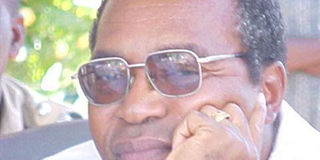
Former Ilala MP Ukiwaona Ditopile Mzuzuri. He was among 41 parliamentary seat winners during the October 1990 election. His opponent, Mwinyi Juma Mwinyi, petitioned against his victory but lost. Photo | file
Dar es Salaam. In any election involving more than one contestant there must always be the winner and the loser. So, President Ali Hassan Mwinyi, on August 9, 1990, appointed seven members of the National Electoral Commission (NEC) to hear election petitions.
The Head of State made the appointments after the Constitution was amended to allow a new NEC structure, which was tasked to supervise preparations and supervision of the General Election of the United Republic of Tanzania.
Judge Lameck Mfalila of the Court of Appeal was among members appointed to hear the petitions. He was later picked to become the chairman of the electoral body.
The other members, who joined Mfalila were Judge Salehe Abdallah Dahoma of the High Court of Zanzibar, Bernadetta Kunambi and Mohamed Faki Mohamed.
Besides supervising the polls, NEC was tasked to deal with election irregularities and misconducts.
Soon after the results of the October 1990 polls were announced, election petitions began to flow in. On February 14, 1991, hardly four months after the polls, NEC unveiled its schedule of hearing petitions at its Dar es Salaam head office.
The petitions that involved 41 constituencies were planned for hearing in 19 petition hearing stations.
NEC secretary Nathaniel Issa announced that 45 election petitions in Tanzania Mainland and those in Zanzibar were planned for hearing in different stations on both the mainland and on the Isles, starting from February to December 1991. The Attorney General took his share of blame from every election petitioner.
To mention a few election petitions, Mwinyi Juma Mwinyi petitioned against Ukiwaona Ditopile Mzuzuri, who was declared the winner of the Ilala parliamentary seat. Mwinyi’s petition was set for hearing on March 25 at the Dar es Salaam petition hearing station.
Another petitioner was Hussein Hading’oka against Halfan Mng’ago, who was declared the winner of the Ubungo parliamentary seat. Hading’oka’s petition was set for hearing on April 4.
Edmund Rutaraka (Bukoba Rural) was petitioned against by Sebastian Kinyondo, whose petition was set for hearing at the Bukoba station on 13 May.
On July 22, at the Arusha station, Solomon ole Saibul’s petition against Ole Sirikwa and four others (Arumeru West) was heard.
The schedule showed that the first election petition to be heard involved Hassan Chande Kigwalilo, who petitioned against Lieutenant Colonel Abbas Ngayaga, who was declared the winner of Liwale constituency.
Kigwalilo’s petition was heard on February 25. The last petition to be heard on December 19 at the Mwanza was that filed by Mahmoud Mahmoud and two other petitioners against Pascal Mabiti.
Among the election petitions that were thrown out was that of former Masasi MP, Rajabu Mrope, who petitioned against Kate Kamba over election irregularities.
During the October 28, 1990 polls, Kate Kamba scooped 31,266 votes against Mrope’s 31,030. Mr Mrope was not satisfied with the results on grounds that Masasi’s TRM polling station was closed before the official time.
Mrope also complained that there was no seminar for people, whom he branded “the advocates of election” and that there was a disparity between presidential and parliamentary election votes cast in the constituency.
However, the bench of three judges, under the chairmanship of justice Mfalila, couldn’t hear the petition because Mrope did not fill in the required forms before the election results were announced in accordance with section 115 subsection 2 of the 1985 National Elections Act.
According to section 115 subsection 2 that was amended under the National Elections Act of 1990, the petitioner should have petitioned to NEC through the polling station’s returning officers by filling out any of 1-7 forms.
On March 13, NEC threw out three petitions in Tanga Region because all the defeated contestants had problems with all procedures of the election. The constituencies petitioned were those of Mlalo, Lushoto and Mkinga.
“The complaints that were brought before the NEC were merely the thoughts of the petitioners after the results of the polls were announced as they were all defeated in the elections,” said NEC secretary Nathaniel Issa.
All the petitioners were ordered to pay all the costs incurred by the lawyers of the respondents and as well pay the costs incurred by the Attorney General.
The petitioners were Ibrahim Joseph Shemdoe who petitioned against MP Charles Kagonji; Kigombela who challeged Lushoto MP Raphael Loti Shempemba and Zodo who was dissatisfied with Mkinga MP Luka Kitandula election victory.
On April 9 the team heard petitions in Dar es Salaam Region. Hussein Hading’oka petitioned had against the declared winner of the Kinondoni constituency, Ali Mung’ango. However, Hading’oka was thunderstruck when one of his witnesses betrayed him before the judges.
Hading’oka, who was once an MP, had brought two witnesses to testify on his petition against Ali Mung’ango. When one of his witnesses, Kassim Mng’ombe, was called to testify, he refused, saying that he knew nothing about Hading’oka’s petition.
Mng’ombe, who was the Mabibo Ward Secretary during the election, appeared to be surprised when he was called to testify for the petitioner. Mng’ombe also doubled as assistant returning officer at the ward.
On the second day of concluding his petition, Hading’oka told the judges that the Chama cha Mapinduzi (CCM) party leadership of Kinondoni District frustrated the election, hence contributing to his defeat.
The judges threw out 11 out of 13 petitions on account that the latter were corruption-related and that proper legal procedures were not followed before lodging the petitions.
In Arusha Region, on 16 July, Monduli MP Lieutenant Lepilal ole Moloimet was unseated after NEC annulled the results of the constituency.
“We are announcing that the election of the first respondent, Lieutenant Lepilal ole Moloimet, as the Monduli MP, has been annulled. The respondent is ordered to pay the costs of the petition,” said one of the NEC members, Felician Mahatane. The petitioner was Dr Saleh Moksyo Toure, who claimed that he was slandered by the winner.
Reading out the decision, Mahatane said: “After going through all evidence on slandering, the cause of the slandering and how that slandering was spread, the bench of the judges is satisfied beyond doubt that the slandering has smeared the name and reputation of Toure.”
Toure, who was in 1964 taken aged 11 by Guinean President Alhaji Sekou Toure for studies in Guinea, claimed that Lieutenant Moloimet conducted campaigns clandestinely and he smeared and branded him ‘Layoni’, a name latterly meaning in Maasai ‘an uncircumcised person’ and he called him as a little child who did not deserve to be given a leadership position. However, in a by-election Molloimet and Toure were picked again by their party to contest for the Monduli parliamentary seat. The nomination was made on October 29, 1991 by the Central Committee of the National Executive Committee, which held its sitting in Dodoma, where it also made the final selection of CCM members, who sought to contest for positions of CCM chairpersons for Ngorongoro District and Arusha Region.
However, Molloimet was reelected, defeating Dr Salash Makosyo Toure who got 5,913 votes against 14,254 votes collected by Molloimet.
Of all the petitions, the one filed against former Prime Minister and First Vice President Joseph Warioba was the one that attracted the feelings of most people.
The petition resulted in Warioba to lose his seat. In the October 1990 polls Warioba got 35,522 votes against Ramadhani Mkondya’s 4,552.
How did it come about for Joseph Warioba to lose his seat? What did a panel of NEC, led by Judge Mfalila, discover? Read our tomorrow’s edition for the full story.