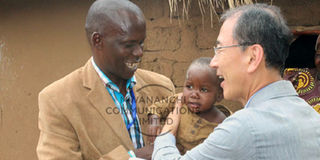
Global Saemaul Development Network (GSDN) President, Prof Choioe Choo, holds a child during his recent visit to Sangabuye Ward in Ilemela District, Mwanza Region. The area is amongst the least developed wards in the district. PHOTO | FILE
Mwanza. Tanzania has been urged to adopt the model used by South Korea in 1970 to modernise rural settings dubbed ‘The Saemaul Movement’.
The advice was issued by Prof Choioe Choo, president of the Global Saemaeul Development Network while on his tour of Ilemela District.
He said the movement has been accepted by the United Nations as one of the models to be used in modernising rural areas.
“At least 144 countries have adopted this movement and 56,314 people have been trained on how to implement the model,” he said.
Prof Choo said the movement promotes self-help and collaboration among people while the central government provides a fixed amount of raw materials to each participating villages free of charge and entrusts the locals to construct modern buildings.
Mr Choo said in the 70s when the movement started the government selected 33,267 villages and provided each with 335 bags of cement. Out of these, 16,600 villages showed progress and were granted an additional 500 bags of cement and one tonne of iron bars.
He added that the community movement improves infrastructure in rural areas across South Korea.
Prof Choo added that the movement also marked the switch from traditional thatched huts better known as ‘Choga-Jip’ houses to modern structures.
Ilemela District Commissioner Manju Msambya, called on strong leaders to mentor the people in a bid to implement the movement.
“After the war, South Korea depended on the international community for almost everything but now they are a force to reckon with,” he said.
The Global Seamaeul Development Network, was introduced in 1970 by President Park Chung-hee, the late father of President Park Geun-hye.
It was an initiative to modernise Korea’s rural economy based on the values of self-help, diligence and public participation.