Analysts support Russia ties, caution on geopolitics
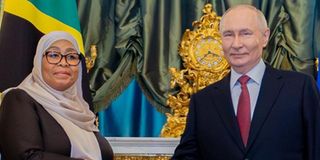
President Samia Suluhu Hassan shakes hands with her host, Russian President Vladimir Putin, ahead of bilateral talks at the Kremlin in Moscow, Russia. Analysts have defended President Hassan’s visit say it is in tandem with Tanzania’s foreign policy. PHOTO | FILE
Dar es Salaam. Analysts have defended President Samia Suluhu Hassan’s assertion that Tanzania does not align itself with competing geopolitical blocs, saying her recent state visit to Russia is consistent with the country’s long-established foreign policy of non-alignment and pragmatic engagement.
However, they have cautioned that Tanzania must carefully navigate an increasingly complex international environment as major powers intensify competition for influence across the globe.
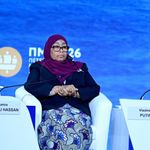
President Hassan made the remarks during an interview with Tanzanian journalists on the sidelines of the 29th St Petersburg International Economic Forum (SPIEF 2026) on Friday, June 5.
She dismissed suggestions that her state visit to Russia signalled a shift in Tanzania’s foreign policy orientation, maintaining that the country remains committed to working with all nations in pursuit of its development objectives.
“We work with everyone. We don’t choose who to work with. By coming to Russia, we are simply expanding the scope of those with whom we closely cooperate,” she said.
Her comments followed speculation that selecting Russia for her first state visit after re-election indicated a move away from Western partners towards Eastern powers.
President Hassan rejected that interpretation, arguing that Russia is not a new partner but one of Tanzania’s oldest diplomatic allies.
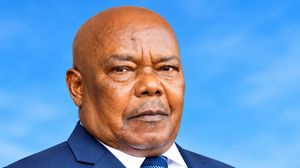
A political analyst from the University of Dar es Salaam, Mr Salbinus David, said Tanzania’s engagement with Russia should be viewed within the broader context of the country’s longstanding diplomatic principles.
“Tanzania has historically maintained a non-aligned and pragmatic foreign policy posture. The country has never subscribed to choosing friends or partners based on global power rivalries. What matters is whether a partnership advances national interests and contributes to economic development,” he said.
According to Mr David, Tanzania’s approach has traditionally centred on maintaining constructive relations with a wide range of countries while safeguarding its sovereignty and development priorities.
For his part, a political analyst from the State University of Zanzibar, Prof Ali Makame Ussi, said the current global environment requires countries such as Tanzania to place greater emphasis on economic diplomacy rather than geopolitical alignments.
“The focus should be on expanding opportunities for trade, investment, technology transfer and industrial development. Any country that presents such opportunities should be considered a potential partner. Tanzania should not sideline any nation simply because of the strategic interests or preferences of other powers,” he said.
He added that developing economies increasingly need diversified partnerships to support growth, attract investment and enhance competitiveness in a rapidly changing global economy.
A political scientist from the University of Dodoma, Dr Paul Loisulie, said broadening international partnerships was important, but warned that Tanzania must remain alert to evolving geopolitical realities.
“The world is becoming increasingly complex, with major powers competing for influence across different regions. Tanzania must continue engaging strategically, guided by its development priorities rather than ideological camps,” he said.
“The key is to cooperate with partners based on mutual benefit and national interests, not on who is aligned with whom in global politics.”
President Hassan noted that relations between Tanzania and Russia date back to the country’s independence struggle and the liberation movements that helped shape Africa’s political history.
She said the former Soviet Union recognised Tanganyika’s independence in 1961 and became the first country to recognise the union between Tanganyika and Zanzibar that created the United Republic of Tanzania in 1964.
“Russia is not a new friend. It is a traditional friend that has stood with Tanzania for many years,” she said.
The President reiterated that Tanzania’s foreign policy remains rooted in non-alignment and constructive engagement with all nations, regardless of geopolitical divisions.
To illustrate the country’s balanced diplomatic approach, she cited China’s contribution to infrastructure development, India’s position as one of Tanzania’s leading trade and investment partners, and ongoing cooperation with Japan, Europe and the United States across various sectors.
“Europe remains a major source of investment capital, while the United States is our leading source of tourists and development support,” she said.
She added that strategic projects such as the liquefied natural gas (LNG) project and major mining investments involve partners from Europe and the United States.
“When we talk about LNG and natural gas, we are working with Europe and America. Kabanga Nickel also involves American investment,” she said.
President Hassan was in Russia for a three-day state visit at the invitation of Russian President Vladimir Putin.
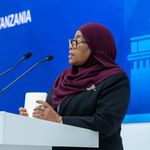
During the visit, she held bilateral talks with President Putin, received an honorary doctorate from the Peoples’ Friendship University of Russia (RUDN University) and addressed investors at SPIEF 2026, where she promoted Tanzania’s investment opportunities.
She also attended the Tanzania-Russia Business Forum and urged investors to support Tanzania’s ambition of becoming a $1 trillion economy under Vision 2050.
Despite growing diplomatic engagement between the two countries, trade volumes remain relatively modest.
Official figures indicate that bilateral trade increased from $178.8 million in 2020 to approximately $307.5 million in 2025. Tanzania’s exports to Russia also rose from $7.5 million to $29.5 million during the same period.
Russia’s largest investment in Tanzania remains the $1.2 billion Mkuju River Uranium Project in Ruvuma Region. The project is being developed by Mantra Tanzania Ltd, a subsidiary of Russia’s state nuclear corporation, Rosatom.
Analysts say the growing relationship demonstrates Tanzania’s determination to diversify its international partnerships while maintaining a foreign policy that prioritises national development interests over geopolitical alignments.
Register to begin your journey to our premium contentSubscribe for full access to premium content