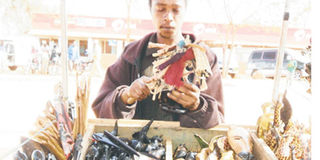
A potential customer assesses a carving at a stall at Masaki, on the outskirts Dar es Salaam city. PHOTO|FILE
What you need to know:
Somewhat like the corner ball kick for which players crowd in the small goal-mouth area to either score or ward off that prospect, the carvings attract various stakeholders, some of whose interests conflict sharply.
Dar es Salaam. Retention of the status of Makonde carvings as one of the potent advertisers of the Tanzanian nation can be guaranteed only by various problems that revolve around art form to which Mozambique is the only other country lays claim.
Somewhat like the corner ball kick for which players crowd in the small goal-mouth area to either score or ward off that prospect, the carvings attract various stakeholders, some of whose interests conflict sharply.
Some, maybe many sellers and agents are fully aware of the procedures and regulations that govern the business, but willfully withhold information in order to protect their business prospects.
They don’t, for instance, inform potential customers about fees and permits related to carvings, without which purchased artworks would be seized by officials at Julius Nyerere International Airport.
The dealers, with a sharp eye on money, and more-so profits, naturally know that tourists who dislike airport hassles would drop the idea of buying carvings.
Some potential buyers operate within set tight budgets, for which the additional cash in the form of fees beyond the purchase price, would be financially disruptive.
The logical option for them would thus be to drop the idea of making purchases. Which, naturally, by extension, would translate into missed transactions and earnings for the inconsiderate, if not outright sinful dealers, who joyfully pocket cash after transactions, while fully knowing that the customers would face music at the airport. They forget, though, within the ‘once-bitten-twice-shy’ context, such customers would not buy artworks – fancied mainly as decorative gifts – as wouldn’t friends, relatives and acquaintances to whom they would give briefings, and who in turn sound off other people.
This partly explains the downward spiral of purchases, which, as was explained in the previous article, is threatening the livelihood of sector participants.
Some tourists who had not set aside emergency funds, or did, but for which coughing up cash to save purchases from confiscation was not a major priority, simply opt to leave them behind, but of course bitterly.
The manager of natural forests of the Tanzania Forest Service Agency (TFSA), Mr Florian Mkeya, explains: “The tourists must have legal permits to take carvings out of the country, especially the ones carved from trees in non-plantation forests, such as ebony, whether for commercial purposes or non-commercial aspects like souvenirs and gifts.
“Most of them reach the airports without a certificate of inspection and permit for export, and this is due to lack of information that merchants don’t give.”
Mr Mkeya explains further that, if a tourist does not submit the documents, his or her items are either confiscated by officials of the ministry of Natural Resources and Tourism at the airport or they are made to pay a considerable amount of money as fees according to the weight of specific items in order to retain them.
The material used for Makonde carvings and artifacts is ebony, which is graded as a first class, non-plantation forest product. “Hardwood, such as ebony, has been exploited since German colonial times for such carvings. Ebony is now scarce as it is available only in natural forests. There are no plantations specifically for the species, ” Mr Mkeya explains yet further. The natural forest belt embracing part of Tanga, Coast and Mtwara regions.
So far, no tree is banned for utilisation in Tanzania, except that limitations have been set. This is a global phenomenon related to natural forests, whereby harvesters have to follow a set of procedures, laws and regulations for getting the materials.
TFSA’s Director of Planning and Resource Utilization, Mr Mohammed Kilongo notes: “The big problem is that some merchants are ignorant about the procedures on how to get clearance for harvesting forest products. We are aware of the problems Makonde artists and merchants face, but we can do very little if they are unwilling to co-operate in learning these procedures, which are very clear and straightforward.” The merchants or woodcarvers need to pay royalty on raw materials, which is Sh264,960 per cubic metre as fee for products like ebony. This applies where the product is cut and removed by the licensee from government-owned forest reserves.
“The merchant can only harvest the hardwood from the government- owned forest reserves, if they have a harvesting permit issued here at TFSA and other branches of the ministry in Kilwa, Rufiji and Lindi,” adds Mr Mkeya.
Requirements
The purchasers need to be informed by the registered merchant on the legal process of transporting the Makonde carvings for commercial or non-commercial aspect outside Tanzania. Travellers, foreign or local, need to have a certificate of inspection (grading) and a permit for export, both available at the TFSA headquarters, either by the purchaser or the agent/merchant the buyer is purchasing from. These two documents are must be submitted to the relevant desk at the Julius Nyerere International Airport.
In case the purchaser has neither the permit nor receipts to be presented to ministry of Natural Resources and Tourism officials at the airport, the fee for Mpingo (Ebony) carvings is Sh4,600 per kilogramme, Sh3,000 per kilogramme for other carvings and Sh1,700 for small pieces.
Items whose value exceeds $300 will be considered as commercial consignments and items valued at less or equal to USD300 are considered as non-commercial consignment.
Drawbacks
The handicraft industry is tangled between restrictions faced by the purchaser and limitation on handicraft materials. “It is a complex issue. Ninety five per cent of dealers don’t follow procedures. In fact, most of the dealers running shops in various parts of Dar es Salaam are not registered. ” Mr Mkeya says.
He lamented, too, that some of them cut down trees without approval from the ministry, and this a precious resource that we have been striving to conserve for several years. The indiscriminate felling of ebony trees has prompted the government to tighten procedures for taking carvings out of the country. “We are aware that tourists have been complaining about the restrictions, but they should understand our role and priority which is the forest products. We are not concerned with tourism products. Complaints focus on only one side of the coin. We cannot allow let tourism to have negative impacts on our environment, or allow continuous illegal exploitation of forests,” Mr Mkeya added.