Dar es Salaam. The Catholic Church in Tanzania is considering introducing a policy that would require all its institutions, parishes and Small Christian Communities to bank with Mkombozi Commercial Bank, in a move aimed at strengthening the lender's growth while encouraging economic self-reliance among the faithful.
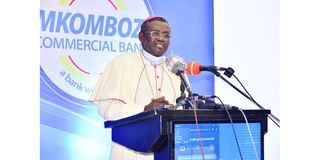
The proposal was made by the Archbishop of the Archdiocese of Dodoma, Beatus Kinyaiya, who called on fellow bishops to adopt a common policy requiring Church-owned entities—including schools, hospitals, parishes and outstations—to conduct their banking through Mkombozi.
His remarks came during the bank's 17th Annual General Meeting (AGM) in Dar es Salaam at the weekend, after shareholders questioned why some Catholic parishes still deposit offertory collections and other Church funds with commercial banks instead of Mkombozi, a bank established with strong links to the Catholic Church.
"In Dodoma, every Small Christian Community, every outstation and every parish is required to use Mkombozi Bank," Archbishop Kinyaiya told shareholders.
"I am urging my fellow bishops to adopt the same policy so that all our Church institutions, including schools and hospitals, use Mkombozi. If we truly believe in this institution, we must support it."
The Archbishop described the move as an expression of stewardship and economic patriotism, urging Catholics to take personal responsibility for growing the bank by opening accounts and encouraging others to do the same.
"Every parent here should ensure their children have a bank account with Mkombozi. We should also encourage our relatives and friends to join. Parish and outstation leaders must demonstrate confidence in this bank because its success depends on our collective commitment," he said.
He added that the bank's long-term ambition is to expand its footprint across Tanzania so that more citizens can access quality financial services.
Meanwhile, Mkombozi Commercial Bank Managing Director Respige Kimati said the bank has begun strengthening its sustainability reporting and governance systems as part of efforts to comply with evolving regulatory requirements and improve transparency.
He said the initiative would enable the bank to provide more comprehensive disclosures on governance, accountability and sustainable development, in line with legal and regulatory expectations.
"We are building robust systems for collecting, processing and assuring the quality of data. This will enable us to produce more comprehensive institutional reports that meet the standards required by law and relevant regulations in the coming years," Mr Kimati said.
He added that the bank continues to invest heavily in human capital, spending Sh171.9 million on staff training during the year in line with the Bank of Tanzania (BoT) guidelines and the bank's internal capacity-building policies.
According to Mr Kimati, the training programmes include mandatory professional development courses aimed at improving staff competence and service delivery.
He said the bank also remains committed to employee welfare through staff loan schemes, healthcare services and the protection of retirees' rights, while promoting gender equality in recruitment and leadership positions in accordance with government policy and regulatory expectations.
The bank's Board Chairman, Gasper Njuu, announced that shareholders approved a dividend of Sh100 per share for the 2025 financial year, up from Sh92.40 paid the previous year, reflecting improved profitability.
He said Mkombozi recorded a pre-tax profit of Sh17 billion for the year ending December 2025, representing a 48 percent increase from Sh11.49 billion posted in 2024.
Mr Njuu attributed the strong performance to improved operational efficiency, wider adoption of digital banking services and continued growth in the customer base.
"Our vision is to establish a presence in every region and every major commercial town where our customers are located. We invite prospective customers to support our services because our policy is clear—we are committed to building a bank founded on the highest standards of integrity," he said.