Contaminated jet fuel could cost oil companies Sh28bn
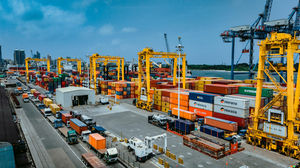
An aerial view of Dar es Salaam’s Julius Nyerere International Airport, where the bulk of jet fuel imported into the country is supplied. PHOTO | FILE
What you need to know:
Puma, Oilcom and Gapco have a combined stock of 28,131,341 litres of contaminated JET A1 fuel in their storage facilities in Dar es Salaam.
Dar es Salaam. Three oil companies are staring at a staggering loss of up to Sh28.13 billion in costs for the contaminated jet fuel that was recently imported into the country, it has emerged.
Puma, Oilcom and Gapco have a combined stock of 28,131,341 litres of contaminated JET A1 fuel in their storage facilities in Dar es Salaam.
A litre of JET A1 fuel, largely used by jet aircraft, costs about Sh1,000.
The discovery of the impure fuel has opened a battleground among the companies, the bulk procurement agency and the supplier over who should shoulder the blame and pay the bill.
The matter is also threatening to disrupt the aviation industry should contingency measures not be taken to ensure enough and clean JET A1 fuel is shipped in immediately. Available stock, according to the companies, could only last over the next two weeks.
Puma oil company has the largest of the contaminated fuel at 14,432, 736 litres worth about Sh14.43 billion followed by Oilcom with 10,840,056 litres costing some Sh10.8 billion. Gapco was the other firm with 2,858,546 litres of the dirty fuel valued at Sh2.85 billion. An investigation is on to establish the source of the contamination even as the affected firms appeared to dig in to attempt to shield their shareholders from the huge loss.
A prolonged standoff over the matter could seriously disrupt the supply of the vital aviation fuel. Already, Puma, which has the biggest market share in the country has warned its clients that clean stocks could only last some two weeks from last Friday.
The three oil companies plus Total, have a combined clean stock of 8,749,810 litres of JET A1 fuel valued at Sh8.75 billion. Ironically, both the clean and contaminated stocks were supplied by one company from the same imported volume.
“It is puzzling that supply from the same imported stock has produced the different results by the companies. Some of the dealers are now alleging sabotage and business rivalry over the matter and want an independent investigation,” a source in the industry who did not want his name printed told The Citizen.
Puma, which is 50 per cent owned by the government of Tanzania, has written a protest note to the supplier over the contamination, blaming it on them. The company says the destroyed stock would remain in its storage facilities pending investigations, meaning it could take long for room to be created for new stock.
Should Puma lose out, it means the tax payer will shoulder the burden of the loss for the impure stock. The government last week said it would intervene to ensure the saga did not disrupt supply of aviation fuel in the country.
Our source pointed out that part of the puzzle was that the imported stock was cleared as fit for delivery by Tanzania Bureau of Standards (TBS) as required before its discharge from the vessel. “The supplier is questioning how the same volume could yield two different results at the same time,” explained our source.
Yesterday, Ewura Corporate and Public Affairs Manager Titus Kaguo said an investigation is underway because Puma had lodged a complaint. He said other companies have also raised concern.
“Ewura as a regulator is investigating after Puma has raised an alarm on the matter,” Kaguo said. “We are assessing what might have caused contamination, when, where and why,” he said in a telephone interview.
Mr Michael Mjinja, the acting executive director of the Bulk Procurement Agency, separately told The Citizen that the stock had indeed been certified by TBS. Mjinja noted that the clean stock would run the country up to the first week of June when new stock is expected to arrive.
The Jet A1 fuel was delivered by Sahara Energy Resources Limited who were contracted by the bulk procurement agency for the job. Puma Energy is the largest domestic supplier of Jet A1 fuel and supplies all airports and airstrips in the country.
Reports show Oilcom, Gapco, GBP, Engen and Total received the fuel through Kigamboni based Tanzania International Petroleum Reserve depots. Puma has its own depots.
“We at Total have no problem but our competitors have. We have been holding meetings since last week to resolve the matter but so far there has been no solution,” said a Total official who preferred not to be identified.
But Puma through a private quality firm, Intertek, wrote a protest letter to the master of the vessel which discharged the fuel over impurities.
“Final shore tanks measurement for Jet A1 at Puma was done on 06th May, 2016 and samples drawn from shore tank No. 13, 17, 18 and 23 was tested at our laboratory and we have noted that flash point results for tank number 13 was 34 degrees centigrade, number 17 was 34 degrees centigrade, number 18 was 39 degrees centigrade and number 23 was 36 degrees centigrade and therefore the product at Puma for all tanks above except number 18 was off specification,” an Intertek letter dated May 12, 2016 said.
Intertek further noted that samples collected during the offloading at Kurasin Oil Jetty also had a flash point of-5 degree centigrade against the arrival flash point of 39 degrees centigrade.
“As per the total analysis done above, it’s obvious that the contamination occurred on board during discharge and therefore we lodge a protest in respect of the above and reserve all rights of our principals to refer to this matter at a later stage,” the letter read.
The cargo ship arrived at Dar es Salaam port on May 2 and offloaded 20,000 metric tonnes of petrol and 18,500 metric tonnes of Jet A1 fuel and left the port on May 8.