Hard task ahead for Samia’s newly appointed lieutenants
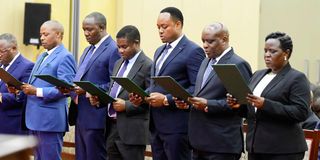
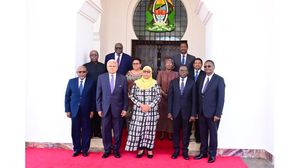
Presidential appointees take the oath of public service ethics immediately after being sworn in at State House in Dar es Salaam yesterday. PHOTO | CORESPONDENT
President Samia says latest reshuffles and appointments were aimed at strengthening institutions and correcting weaknesses
Dar es Salaam. President Samia Suluhu Hassan on Monday, February 9, 2026, issued a series of firm directives to newly appointed Permanent Secretaries, Regional Commissioners and diplomats, urging them to accelerate government performance and secure a lasting legacy by the time she retires in 2030.
Speaking during the swearing-in ceremony at State House, President Hassan said the immediate priority was to ensure that Tanzania is fully prepared to implement its next long-term development blueprint, Dira 2050, which officially begins on July 1, 2026.
She stressed that the next four years would be decisive in laying strong institutional, economic and social foundations for the country’s future.
At the Ministry of Energy, officials were tasked with working around the clock to more than double Tanzania’s electricity generation capacity from the current 4,032 megawatts to 8,000 megawatts by 2030.
The President directed the newly appointed Permanent Secretary for Petroleum and Natural Gas, Dr James Mataragio, to work in close coordination with his counterpart for Electricity and Renewable Energy, Mr Felchesmi Mramba, to deliver on this ambitious target.
“Mataragio, when I swore you in last time, I said you are my spare part, so do not be surprised if I move you around,” she said. “Work with Mramba so that by 2030 we can reach 8,000 megawatts. Gas and oil are your responsibility.”
She underscored that reliable and affordable energy was central to industrial growth, private sector expansion and improved service delivery, noting that delays in power generation would constrain the country’s development ambitions.
Turning to the Ministry of Industry and Trade, President Hassan instructed the new Permanent Secretary, Mr Waziri Rajabu Salum, to work closely with the minister to enhance Tanzania’s competitiveness as an investment destination.
She emphasised the need to deepen industrialisation, expand value addition and strengthen local manufacturing capacity, particularly in the pharmaceutical sector.
Her directive that Tanzania should produce at least 80 per cent of the medicines it consumes by 2030 reflects a broader strategy to reduce import dependence, safeguard public health and build resilience against global supply chain disruptions.
Mr Salum, who previously served as the President’s secretary, was transferred to the Ministry of Industry and Trade, replacing Dr Hashil Twaib Abdallah, who will be redeployed.
Addressing public debate surrounding the move, President Hassan defended the transfer and urged critics to desist from speculation, saying the decision formed part of a deliberate strategy to groom leaders through exposure to diverse sectors.
“Tanzania has many voices, loud ones. Whatever you do is interpreted,” she said. “They say Waziri has been removed; they ask where he is. What I want to tell you is that I have groomed him; he has grown, and now I am exposing him to different sectors. I nurture them, they grow, and I move them on. Otherwise, I would keep them here with me. But I will leave one day; where will their future be? Stop the false talk.”
In the fisheries sector, the President directed Deputy Permanent Secretary Prof Mohamed Shekh to transform the industry into a productive and profitable venture, with particular focus on youth employment.
She pointed to the strong demand for fish and seafood products in Gulf countries and China, stressing the importance of modern aquaculture, improved processing and better market access.
“These sectors have huge demand. Gulf countries need slaughtered and live fish, so we must make an effort. We cannot afford to miss the Chinese market; we must farm properly and realise the expected revenues,” she said.
President Hassan warned that performance would be closely monitored and that accountability would be strictly enforced. Officials who fail to match the pace and direction of reform would be removed to make way for more capable replacements.
“I am watching closely who is performing and how. If your steps do not match the rhythm I am setting, you will step aside so we can find someone whose feet are lighter,” she said.
She clarified that the latest reshuffles, redeployments and appointments were strategic in nature, aimed at strengthening institutions and correcting weaknesses rather than punishing individuals. Removal from office, she said, would only occur when performance fell beyond acceptable limits.
As part of the reshuffle, Colonel Yahya Ramadhani Kido was appointed Regional Commissioner for Kagera, replacing Ms Fatma Mwassa, while Colonel Donald William Msengi was named Regional Commissioner for Mtwara, taking over from Colonel Patrick Kenan Sawala, who will be reassigned.
The President noted the strategic significance of both regions. Kagera borders Rwanda, Uganda and Burundi, while Mtwara shares a frontier with Mozambique.
Their locations, she said, make them critical to national security, cross-border trade and regional stability.
“These regions are vital for defence and strategic to us. They are crucial for the country’s security, and that is why I appointed colonels there,” she said, urging them to work closely with existing administrative and security officials.
Although Kagera has not recently experienced major security threats, the insurgency in Mozambique’s Cabo Delgado Province, bordering Mtwara, remains a concern. Since 2017, Islamist attacks in the gas-rich province have caused widespread displacement, loss of life and economic disruption.
A $20 billion liquefied natural gas (LNG) project near the Tanzanian border was suspended after a 2021 attack on Palma that reportedly killed hundreds. French energy giant TotalEnergies resumed construction in January 2026, signalling renewed investor confidence in the region.
Tanzania, which has also discovered commercially viable natural gas reserves in Mtwara and Lindi, is in the final stages of negotiations with international investors for a $42 billion LNG plant. The project is expected to transform the country’s energy sector, boost exports and generate thousands of jobs.
In her address, President Hassan made it clear that the success of these initiatives will depend on disciplined leadership, institutional efficiency and unwavering commitment to public service. The newly sworn-in officials, she said, carry a heavy responsibility to translate policy into tangible outcomes for citizens and to steer Tanzania confidently into its next phase of development.