How deadly tropical cyclones end up with names of people
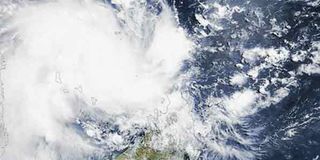
The MODIS instrument aboard NASA’s Aqua satellite provided this visible image of Tropical Cyclone Kenneth on April 24 as it moved into the Mozambique Channel, between Madagascar and Mozambique. PHOTO | WASHINGTON POST
Dar es Salaam. She came first, then her brother. In the twinkling of an eye, both Idai and Kenneth broke hearts, and inflicted wounds that might take decades to heal.
One after the other, the siblings tracked thousands of kilometres across countries, destroying everything on their path, and unleashing untold misery. An eerie warning of a warming world.
Before them 19 years ago, I had an unforgettable date with Eline, an unusual tropical cyclone that kept me locked indoors for three whole days, as she did what she knows best – pounding, pulling down, uprooting and washing away.
And far across the distance, we have read and heard about Dineo and Desmond; and their cousins, notorious hurricanes Wilma and Maria. The list is longer.
They are members of an ‘extended family’ that is globally dreaded for their destructive tendencies.
Apparently a rare, if not utterly new phenomenon in this vast East African country, the back-to-back visitations of Idai and Kenneth this month have left Tanzanians with more questions than answers.
On social media last week, puzzled Tanzanians wanted to find out after they were spared the wrath of Tropical Cyclone Kenneth on Friday: But why do these most intense tropical weather systems have names?
And who decides what they will be called anyway? A relevant question after back-to-back cyclones this strong in the same season, just next door.
Well, it is said that the practice of naming tropical cyclones began years ago. This was to help in the quick identification of storms in warning messages.
Names are presumed to be far easier to remember than numbers and technical terms.
According to the World Meteorological Organisation, there is a rotating list of names which are appropriate for each storm.
But not all storms will be big enough to get names - only those expected to cause significant damage. For example, in the UK a storm will be named when it has the potential to cause an amber ‘be prepared’ or red ‘take action’ warning.
Strangely, according to a recent report by the BBC, research shows that hurricanes with female names are more likely to hurt more people than those with male names. Scientists think that’s because people find female names less threatening, the BBC reports.
In any case, it is hoped that naming big storms will make people more aware of them and how dangerous they can be.
The world’s weather agencies also think it will be easier to follow the progress of a storm on TV, radio, or on social media, if it has a name.
More so, there is a general belief that a name for a cyclone heightens interest in warnings and increases community preparedness.