How Tanzania-Ireland education pact could power Vision 2050
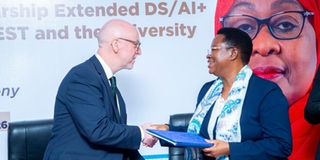
Permanent Secretary in the Ministry of Education, Science and Technology, Prof Carolyne Nombo, and President for Global and International Engagement at the University of Limerick, Prof Colin Firtzpatrick (left) exchange documents after signing agreement that will see the two sides collaborate in transforming education through specialised scholarships for Tanzanian students. PHOTO | COURTESY
At its core is the Samia Extended Scholarship Programme designed to train Tanzanian youth in data science, artificial intelligence
Dar es Salaam. Tanzania’s newly formalised education partnership with Ireland’s University of Limerick is emerging as a strategic building block in the country’s long-term Vision 2050.
This will be by placing human capital, science and technology at the centre of economic transformation.
Signed yesterday at the University of Dar es Salaam, the Memorandum of Understanding (MoU) between the Ministry of Education, Science and Technology and the Irish institution elevates an ongoing scholarship programme into a broader government-to-government framework focused on skills, research and innovation.
At its core is the Samia Extended Scholarship Programme (DS/AI+), designed to train Tanzanian youth in data science, artificial intelligence and related fields- skills widely seen as critical for the future global economy. Minister for Education, Science and Technology, Prof Adolf Mkenda, said the agreement signals Tanzania’s intent to transition into a knowledge-based economy.
“This partnership is timely as Tanzania continues to invest in building a knowledge-based and innovation-driven economy,” he said.
A defining feature of the pact is the University of Limerick’s decision to cover 50 percent of tuition fees for Tanzanian students—an arrangement that not only eases public spending but also expands access to high-quality international education. Already, 32 students are studying in Ireland under the programme, while another 16 are in South Africa, part of a deliberate effort to expose top-performing Tanzanian students to global academic systems.
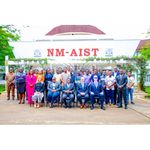
The cohort was selected in 2025 and prepared through a 10-month intensive programme at the Nelson Mandela African Institution of Science and Technology (NM-AIST).
For policymakers, these students represent more than scholarship beneficiaries—they are the foundation of a future workforce expected to drive industrialisation, digital transformation and innovation under Vision 2050.
Ireland’s Ambassador to Tanzania, Ms Nicola Brennan, underscored the central role education has played in her country’s own transformation, offering a blueprint for Tanzania. “Education is hugely important to Ireland. It has been one of the reasons why we have achieved economic growth, prosperity and development,” she said.
She noted that sustained investment in education since the 1960s enabled Ireland to build a highly skilled workforce, attracting multinational companies and foreign direct investment. “As a small nation, we have been able to attract global companies because we offer a highly skilled workforce,” she said.
Her message comes at a critical time for Tanzania, whose population is projected to grow from about 67 million today to over 120 million by 2050—raising the stakes for job creation and productivity.
“The basis of ensuring that young people can take up employment and create opportunities lies in education,” Ms Brennan said, urging sustained investment in quality learning. The MoU goes beyond scholarships. It lays the groundwork for long-term collaboration in research, academic exchange and institutional capacity building—key ingredients in building a competitive innovation ecosystem.
Dr Aikande Kwayu, a member of the programme’s advisory committee, said the initiative aligns directly with Tanzania’s development ambitions. “These are the skills that will define the future. By investing in young people now, Tanzania is building the expertise needed to compete globally,” he said.
He added that international exposure will help students acquire not only technical knowledge but also critical thinking and problem-solving skills essential for innovation.
For Tanzania, the real test will be how effectively these graduates are reintegrated into the economy to drive change—whether in industry, research or entrepreneurship.
Prof Mkenda said the government expects the partnership to expand opportunities, deepen research and deliver tangible development outcomes.
As the first cohort progresses with their studies, the Tanzania–Ireland education pact is increasingly seen not just as a scholarship arrangement, but as a long-term investment in human capital—one that could shape the country’s trajectory towards a skilled, innovation-driven economy by 2050.