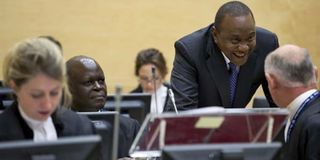
Kenya’s President Uhuru Kenyatta shares a light moment with his legal counsel when he appeared before the International Criminal Court (ICC) in The Hague, on October 8, 2014. ICC Prosecutor Fatou Bensouda yesterday dropped the charges against Kenyatta owing to the insufficient evidence she had gathered against him. PHOTO | file
What you need to know:
“In light of the Trial Chamber’s 3 December 2014 “Decision on Prosecution’s application for a further adjournment”, the Prosecution withdraws the charges against Mr Kenyatta,” the prosecutor said in her application to the court yesterday.
Nairobi. International Criminal Court (ICC) Prosecutor Fatou Bensouda yesterday dropped the charges against Kenya’s President Uhuru Kenyatta owing to the insufficient evidence she had gathered against him.
“In light of the Trial Chamber’s 3 December 2014 “Decision on Prosecution’s application for a further adjournment”, the Prosecution withdraws the charges against Mr Kenyatta,” the prosecutor said in her application to the court yesterday.
She said the evidence had not improved to an extent that President Kenyatta’s alleged criminal responsibility could be proved beyond reasonable doubt.
Ms Bensouda, however, noted that the notice for withdrawal was subject to the possibility of bringing new charges at a later date in case the prosecution obtained sufficient evidence.
“This withdrawal is without prejudice to the possibility of bringing new charges against Mr Kenyatta at a later date, based on the same or similar factual circumstances, should (the Prosecution) obtain sufficient evidence to support such a course of action.”
On Wednesday, ICC judges directed the prosecution to either file a withdrawal notice within one week or provide justification, on the basis of evidence, for proceeding to trial.
The chamber noted that its decision to deny the request for another adjournment, based on the “practical terms and in the circumstances of this case” was likely to have the consequence of ending the proceedings.
The chamber said that, in rejecting the request, it considered the prosecution’s own admission that evidence remained insufficient to support a conviction. The right of the accused to be tried without undue delay and the presumption of his innocence also informed the decision, the judges said. They observed that the two Kenya cases at the ICC — one against Mr Kenyatta and the other facing Deputy President William Ruto and former broadcast journalist Joshua arap Sang — had taken five years.
Remained speculative
Besides, by the prosecution’s admission, it remained speculative whether the information sought in the cooperation request would, even if obtained, be sufficient to support the charges.
In response to the withdrawal, the lawyer for the victims, Fergal Gaynor, said their quest for justice had been frustrated by the decision. “Today’s withdrawal of the charges against Uhuru Kenyatta will inevitably disappoint the estimated 20,000 victims of the crimes charged in this case,” he said.
He accused the Kenya government of “mounting an enormous effort to derail the prosecutions, yet it had done almost nothing to hold perpetrators to take responsibility for the crimes committed.
Meanwhile, Human Rights Watch, said on Friday that the withdrawal of the charges “sets back efforts to end the country’s entrenched culture of impunity.”
“It’s clear that a long tradition of impunity in Kenya and pressure on witnesses have been serious obstacles to a fair process before the ICC.”
President Kenyatta faces charges at the ICC as an indirect co-perpetrator, with five counts of crimes against humanity consisting of murder, deportation or forcible transfer, rape, persecution and other inhumane acts allegedly committed during the post-election violence in Kenya in 2007-2008. The charges were confirmed on January 23, 2012, and the case was committed to trial before Trial Chamber V(B).
But on Friday judges directed the prosecution to either file a withdrawal notice within one week or provide justification, on the basis of evidence, for proceeding to trial. The chamber relied on various factors, including the prosecution’s admission that the evidentiary basis remains insufficient to support a conviction.
The judges also took into account the right of the accused to be tried without undue delay and the presumption of his innocence.
On October 8, Prosecutor Fatou Bensouda had told the court that nothing had changed from what she had reported in December 2013: that she did not have sufficient evidence to prove that Mr Kenyatta was guilty of crimes against humanity.
She was not sure either if whatever new evidence she would obtain, principally from the government and from Mr Kenyatta’s records, would be enough to convict him.
Unless Ms Bensouda has found new witnesses — and it is not known if she has — or comes upon records or other evidence that would bolster her case, then in a week she must go to court and request the judges to withdraw the case. If she does not, the judges will likely step in and do so themselves.
But judges Kuniko Ozaki, Robert Fremr and Geoffrey Henderson left the door open for Ms Bensouda, should she withdraw the current case, to charge Mr Kenyatta afresh with the same offences if she got the evidence at some point in the future.
They, however, refused to grant her request to adjourn the case indefinitely — until the government provides all the records she had asked for — even though they recognised that not granting the adjournment “is likely to have the consequence of ending the proceedings”.