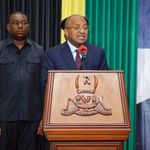
Inspector General of Police Ernest Mangu said Mr Hamad’s actions and words were well documented and police could arrest him on the strength of evidence they had against the opposition politician.
Dar es Salaam. The political situation in Zanzibar is set to take a turn for the worse after police said yesterday that they had enough evidence to arrest CUF Secretary-General Seif Shariff Hamad on suspicion of sedition.
Inspector General of Police Ernest Mangu said Mr Hamad’s actions and words were well documented and police could arrest him on the strength of evidence they had against the opposition politician.
Mr Mangu’s comments came a few days after Commonwealth Deputy Secretary-General Josephine Ojiambo said in London that the organisation planned to engage the government and CUF in finding an amicable solution to the drawn-out political crisis in Zanzibar.
Dr Ojiambo held talks with Mr Hamad and Tanzania’s High Commissioner to the UK, Dr Asha-Rose Migiro, in a meeting organised by the Royal Institute of International Affairs.
“The presence of CUF secretary-general and the High Commissioner of the United Republic of Tanzania at this important event here means we can count on the two sides to support the initiative,” she said during the meeting held at Chatham House in London on Friday. But speaking in an interview on Azam Television yesterday, Mr Mangu accused Mr Hamad of inciting civil disobedience in Zanzibar.
“Mr Hamad’s file is already with the Zanzibar Director of Public Prosecutions, and he may appear in court any time.”
Mr Mangu said last year’s General Election in Zanzibar, whose results were annulled, and the controversial March 20 repeat elections were both peaceful, and the situation deteriorated after the rerun, which was boycotted by CUF.
He added that Mr Hamad, who claimed he won the annulled presidential election, precipitated political tension in Zanzibar after holding a series of closed-door meetings in Pemba following cancellation of the results.
“After the meetings we started to notice an upsurge in attacks on property belonging to those who are not affiliated to the Opposition. It also reached a point where people who are not CUF supporters were denied service at businesses owned by people backing the party.”
Mr Mangu said police had established that Mr Hamad was directly responsible for the tension after making inflammatory remarks during the closed-door meetings.
Soon after his tour of Pemba, Mr Hamad was questioned by police in Unguja in May and freed without charge, but Mr Mangu said that did not mean the CUF secretary-general was off the hook.
Mr Hamad could not be reached for comment yesterday as he was out of the country, but CUF Director of Information and Communications Hamad Masoud defended his boss, although he said he did not see the interview.
He said Mr Hamad did not commit any criminal offence during his meetings in Pemba.
“Mr Hamad and all of us in the party are in a political struggle. He has not committed any offence, although he is no stranger to police interrogations, courtrooms and even prison cells. No amount of threats will deter us from defending what we believe is just and right,” Mr Masoud said, adding that Mr Hamad would arrive home tomorrow and “we’ll see what police will do”.
Mr Hamad said in London on Friday that the situation in Zanzibar put the archipelago on the brink of anarchy.
He warned that Zanzibar, with its multitudes of unemployed youth, had all the ingredients needed to make it fall prey to “extremist” elements in the region.
“The international community must see to it that it averts this scenario from happening by supporting democracy in Zanzibar,” said Mr Hamad, who was accompanied by, among others, CUF Director of Foreign Affairs Ismail Jussa.
CUF leaders had been pleading with the youth to remain calm as they sought an amicable solution to the crisis caused by the annulment of last year’s election results, Mr Hamad said.
“Our young people are asking us, their leaders, how many stolen elections should they tolerate. When we allow five consecutive elections to be stolen, what message are we sending to our young people?”
He warned that the situation in Zanzibar was getting out of hand and urged the international community to act immediately.
In Dar es Salaam, Mr Mangu said police should be left to perform their duty when asked if he did not think that arresting and charging Mr Hamad would worsen the situation and dash any hopes of an amicable and lasting solution to the impasse in Zanzibar.
“My duty and that of the Police Force collectively is to discourage and prevent crime, but if crime happens, then it is our duty to bring the perpetrators to justice, regardless of their social or political standing. “I’m not a politician, and I can’t talk about political consensuses here...that’s up to politicians. If they want to go back to the negotiating table, that’s all well and good,” Mr Mangu said.
Meanwhile, the IGP defended last week’s questioning by police of Mwananchi Managing Editor Frank Sanga and reporter Elias Msuya.
The duo were questioned on Thursday and Friday about an opinion piece penned by Mr Msuya that was published on Wednesday under the headline Polisi na hofu ya watawala kuondoka madarakani (Police and rulers’ fear of relinquishing power). Mr Sanga and Mr Msuya have been ordered to report to Central Police Station again today.
Mr Mangu said the interrogation was aimed at establishing whether there was “malice” in the article for which the two could be taken to court.
However, if it would be concluded that the article was a result of a “professional lapse”, the matter would be referred to the Ministry of Information or media regulatory bodies, he said.