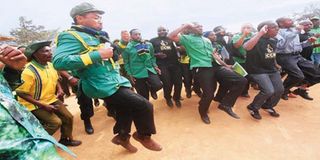
Ruling party, CCM, deputy secretary general (Mainland), Mr Mwigulu Nchemba, joins CCM youths for a drilling session during a campaign rally for Kalenga by-election at Ifunda area in Iringa Region yesterday. PHOTO | EDWIN MJWAHUZI
What you need to know:
The alliance was announced here yesterday, a day after debate on the proposed standing orders indicated that dissenting voices would likely not get a formal hearing.
Dodoma. Some members of the Constituent Assembly (CA) have formed an alliance, ostensibly to articulate opposing views, in what appears to be an attempt to counter the ruling Chama Cha Mapinduzi’s plans to use its numerical strength to push through its agenda.
The alliance was announced here yesterday, a day after debate on the proposed standing orders indicated that dissenting voices would likely not get a formal hearing.
The group, dubbed the Alliance for People’s Constitution and going by the Kiswahili acronym Ukawa, says its chief responsibility will be to defend public opinion as represented in the second draft of the proposed new constitution compiled by the Constitution Review Commission (CRC). It was chaired by Justice (rtd) Joseph Warioba.
According to Ukawa founding member Prof Ibrahim Lipumba, the alliance will focus on 10 issues aimed at consolidating public opinion in pursuing a people-centred constitution.
Ukawa, which is a non-political outfit, will accept members from groups and parties that subscribe to opinions expressed by wananchi via the second draft constitution. It is said to be comprised members from the ruling party, the opposition and representatives of other interest groups.
Speaking at a press conference at Parliament grounds, he added: “We are not going to allow members who advocate the interests of their parties or groups. Ours is a group that seeks to defend the people’s interests.
Anyone who believes in what we stand for is free to join us, irrespective of his political or social affiliation.”
Present at the high table were NCCR National Chairman James Mbatia, Chadema Central Committee member Prof Abdallah Safari and Ms Pamela Maassay, who represented people with common interests.
According to Prof Lipumba, Ukawa has been holding a series of open meetings in the past week to publicise the alliance and lobby other members to join them.
Ukawa has more than 100 members, according to Prof Lipumba, and the recruitment drive continues. Ukawa has yet to choose its leader and it has appointed a team under Prof Safari’s chairmanship to scrutinise the draft of CA standing orders that was tabled by Prof Costa Mahalu, who led the 20-man team that drafted the standing orders.
Prof Lipumba said Ukawa generally supported recommendations by the Prof Mahalu team that drafted the standing orders. Some of the Mahalu team’s recommendations that Ukawa supports include the secret ballot, which CCM objects to.
Ukawa also supports a proposal that a CA meeting should not start without a quorum of at least 50 percent of members from each part of the union. Ukawa also supports the recommendation that dissenting views should be tabled in the assembly alongside committee reports.
Responding to questions from reporters, Prof Safari reiterated that Ukawa prefers the secret ballot because it will give CA members the freedom to make their own choice. “There are a lot of examples of people having suffered after making their decision public,” said Prof Safari. “I once spoke to Christopher Kasanga Tumbo and what he went through after making his decision public was terrible.”
Claims of intimidation and fear of victimisation among members of the CA were made on Thursday as the debate on the standing orders exposed deeply emotional views on the voting method.
Virtually all members who spoke on the second day of the debate spent their time on the thorny issue of whether the assembly should adopt an open or secret voting system, with some suggesting that an invisible hand may be out to manipulate delegates.
The other two of the 87 items under the Standing Orders that received substantial mention were the quorum and how to treat “dissenting” views during proceedings.
The CA came to life on Wednesday following the tabling of the Standing Orders by Prof Costa Mahalu on behalf of a special committee that had been tasked to prepare them for debate.
It is widely believed that CCM directed its members to push for an open ballot system in order to check those from its flock who intended to deviate from the party’s stand on various aspects of the Draft Katiba. Some CCM members reportedly fear being punished if they openly express a stand against the party’s preferences.
But a number of prominent CCM legislators publicly declared that they would not support open voting on the grounds that it went against democratic principles.
Ms Ester Bulaya (Special Seats) and Prof Juma Kapuya (Urambo West) expressed support for the secret ballot when they stood up to air their views. An open voting method, they said, would violate their basic rights and run counter to Section 27 of the Constitution Review Act 2011.
Prof Kapuya, a former Cabinet minister, warned that the open ballot would expose members to threats and divide the nation as the public would judge their representatives on the basis of the way they voted.