Shared responsibility crucial to preparing future-ready students
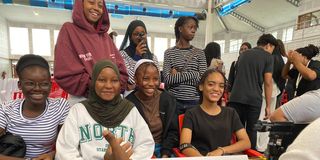
Aga Khan School students engage with industry professionals during the Annual Career and Internship Fair on Saturday, February 28. Photo | Ramadhani Ismail.
Dar es Salaam. One of the biggest questions confronting students as they progress through school is what they will do after graduation and who they aspire to become.
For many, the uncertainty begins at home, where parental expectations, personal interests, classroom learning and labour market demands do not always align.
In a bid to bridge this gap, the Aga Khan Education Service, Tanzania (AKES, Tanzania) organised its annual Career and Internship Fair on February 28, bringing together students and professionals under one roof.
The event sought to expose learners, from an early stage, to diverse career pathways, internship opportunities and emerging professions across multiple sectors.
This year’s fair featured participants from technology, finance, healthcare, engineering, development banking, hospitality, marketing, biomedicine, psychology, fintech, media, law, aviation and digital content creation.
Speaking during the opening ceremony, AKES Tanzania Chief Executive Officer, Dr Shelina Walli, said such platforms are not about compelling students to make immediate career decisions, but about helping them understand available opportunities in relation to their aspirations.
“We know that in today’s statistics, students or professionals change at least four to five careers in their lifetimes, and there is anticipation that in the next five to seven years, this number is going to rise to seven to nine careers,” she said.
She emphasised that early exposure plays a critical role in shaping students’ long-term journeys.
“If you don’t start now, then you’re not building the path that you need to walk on,” she added.
Dr Walli also challenged employers to strengthen mentorship structures and offer young people honest insights into workplace realities.
“The commitment of coming to guide younger people is that of mentorship. It is about sharing the honest reality of what it actually means to be in the workforce,” she said. Turning to educators, she urged teachers to adapt to changing times.
“Learning has changed. Living has changed. If we are not able to change the teaching and the provision, who is going to? Not them — us,” she said.
She also sought to allay fears that technology threatens employment, noting that innovation should be viewed as an enabler rather than a replacement for human effort.
From a professional perspective, Human Genetics expert Dr Mohamed Zahir advised students to reflect carefully on their personal interests while still young.
“No matter what kind of career you pick, that will be something you are going to do for most of your life. So do something that you love. Never do what you don’t want to do. Choose work that strengthens the skills you enjoy,” he said.
Beyond passion, he stressed the importance of communication skills in today’s fast-changing world. “We live in an era where communication is everything. Learn how to write an email properly, learn how to message professionally, and be productive in whatever you want to become,” he added.
Adding to the discussion, Primary Years Programme (PYP) Coordinator at Aga Khan Primary School, Lynette Kyalo, reminded students that beginnings do not determine endings.
“Your starting point does not define your end point. There is no end to learning, and there is always room to upscale what you do,” she said.
Strategic Technologist Amina Iddy highlighted the shared responsibility among students, parents and employers in shaping career readiness.
“All of us need to be good listeners,” she said. “Students must expose themselves to different environments, stay updated, join clubs and volunteer. That is how growth happens.”
From the students’ perspective, International Baccalaureate Diploma Programme Year 2 student Jshanvi Thakur underscored the importance of networking.
“Networking is one of the most powerful things you can do. It takes you places, not only grades or academics. Building good relationships with people opens many doors,” she said.
As discussions unfolded among professionals, educators, parents and students, one theme stood out: preparing young people for the future is a shared responsibility.
The annual Career and Internship Fair has thus become more than just a date on the school calendar. It serves as a platform where expectations, aspirations and real-world realities intersect — offering students guidance in an era where career paths are no longer fixed, but constantly evolving.