SPECIAL REPORT : The plight of a school with only 2 teachers for 510 pupils
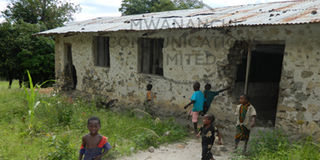
A group of pupils play at a dilapidated classroom block at Chohero Primary School.
PHOTO | NUZULACK DAUSEN
What you need to know:
Deep in their village, theirs is an existence so remote that for many of these young boys and girls, the only thing that gives them a glimpse of the civilised world out there is a motorcycle that drops a passenger, once in a while.
Chohero. Like pupils from many other rural communities in Tanzania, they wake up in the wee hours of every week day to prepare for school.
Deep in their village, theirs is an existence so remote that for many of these young boys and girls, the only thing that gives them a glimpse of the civilised world out there is a motorcycle that drops a passenger, once in a while.
But that is the least of the concerns of the 440 pupils at Chohero Primary School. Perched on a hill in Chohero Village, Mvomero District, the school is arguably one of the oldest public educational institutions around – having been operating since 1971.
Yet ever since, it has had to run with an acute shortage of teachers, currently at its worst with a pupil-teacher ratio (PTR) of 1:220, according to information sourced from the open data portal in the President’s Office, Regional Administration and Local Government.
PTR is the number of pupils enrolled in a particular school divided by the number of teachers available. This, however, doesn’t put into consideration the fact that a teacher can teach in a class with more pupils than the figure stated as PTR.
As of March last year, Chohero was listed among the 11 schools with the lowest number of teachers.
Mr Bernard Pius, the school’s head teacher, fell short of describing the school’s continued existence as a miracle, revealing to The Citizen recently that they have been operating with only two teachers for a whole two years.
“We have two teachers only, and this is almost the second year in this difficult situation. We are required to teach about 510 pupils,” he said.
The situation on the ground is worse than the tale told by officials.
Survival strategy
Due to the shortage, Mr Pius and his colleague Henry Matanji have divided their workload based on level of classes. Unsustainable as this arrangement is, it’s a survival strategy that has kept them afloat – at least for over 24 months now.
Mr Pius teaches the lower level, from pre-primary up to Standard 3, while his colleague takes up Standard 4 to 7 classes. But because the pupils also outnumber classrooms and desks, the two work on shifts.
“I don’t know even the exact number of periods I have per week. There is just too much for two, so we try as much as possible to take what we can,” says Mr Pius.
He adds: “What I care about the most is to ensure that these pupils at least learn how to read, count and write. We also take them through health and sports sessions, but only as much as time permits.”
For more than 10 years, the school has been enrolling an average of 400 pupils each year. But they have never been taught by more than six teachers at any given time.
Most teachers posted to the school seek transfers even before they settle down – and at the slightest opportunity they take flight to places with better working conditions.
When Mr Pius joined the school as head in 2002, he found four teachers there. He became the fifth.
But a year later, one teacher died, while two others successfully sought transfer within four years.
“The government brought two more teachers in 2014 to fill the gap. One was transferred in 2015 and another was moved early this year (2016),” he says.
Most of those who come to teach at Chohero are from Morogoro Region, and the school head says they are usually from the local Luguru tribe.
“Teachers from other regions can’t stay for long here because of poor infrastructure and the lack of basic social services,” he tells The Citizen.
Besides the nightmare one has to face getting transport to the school, communication with the outside world is almost always made impossible due to poor mobile network.
And the journey to Chohero is not a joke. It’s only the physically fit that can take on the 20-km walk from the nearest bus stop at Nyandira – the last point accessible by motor vehicles.
Beyond this point, it’s fair enough to say that there is no road. People living in Chohero and surrounding villages have to walk for at least three to four hours before they get a bus to Morogoro town.
Dusty, rough road
For more than 40 years, people in this village have been relying on donkey carts, and lately, bodaboda that can easily navigate the dusty, rough road that meanders through a hilly region to the remote area.
But even bodaboda have not always been there. The motorcyclists only started last year after the villagers put their hands together to make a “road” for them.
Still, not all bodaboda riders make it all the way to Chohero. The narrow road passes through the treacherous steep slopes of the Luguru Mountain range, rendering riding almost impossible too.
And if it rains, that place is impassable – not even by foot.
Riding on a bodaboda after a night of light showers, it took me almost two hours to reach the area. Half of the journey, I had to walk because my bodaboda transporter, Mr Rojas Kivalo, couldn’t negotiate the steep mountains with an extra load.
Mr Kivalo would try and try – he would fall down several times, get up and go. At the end of our arduous trip, he had sustained several leg injuries.
Such difficulties have forced bodaboda operators to also shun the area. Most of those who ply the route transport government officials, and visitors. But they need a ‘little convincing’ before accepting to take you on a ride to Chohero.
Yet, there is no end in sight to the transport problem. “It will take even 50 years for us to have a proper road in these villages,” says Mr Kivalo.
For teachers, once they get here, regular trips to town would be a luxury they cannot afford. It costs anything between Sh15,000 and Sh20,000 to hire a bodaboda from Nyandira bus stop to the village.
Donkey-drawn vehicles are now mostly for cargo and personal use.
Consequently, the absence of a proper road to the village makes transporting educational materials like desks, books and chairs to the school difficult.
According to Mr Pius, the government has provided them with desks, but they are yet to be picked from where they were stored somewhere on the way.
No nets, no doors
Back at the school, there are four classrooms – but in two of the old buildings, bricks have started falling off, one by one. No nets, no doors.
Inside, stones are scattered everywhere. They are what make up for the lack of chairs and desks.
Mr Pius says only two classrooms are usable.
It’s a sad sight.
The distraught head says pupils at this school are paying the price of learning in a remote rural area.
A jovial Jackson Udasi, a 12-year who has just started Standard 5 this year, seems to be absorbed. But he is still not oblivious to the difficult surroundings.
He tells The Citizen: “Teachers are trying but they cannot take us through all the periods. We don’t understand much.”
Alex Mkude, a Standard 6 pupil, says despite the difficulties, they love their school, and their two teachers for the sacrifice they made to hang in there.
“Classrooms are not enough, we are forced to sit on the floors during class, but our teachers are doing well. We love them and our school,” he says.
In the 2016 Primary School Leaving Examination (PSLE), Chohero was among the 10 worst performers. Only six out of 49 pupils from the school passed with an average of C.
“Regional leaders asked us why we were at the bottom in the national exams, and we also asked how they expected better results under these circumstances,” Mr Pius says.
“We are trying our best, but there are times you cannot do anything about it. I have been highlighting these problems to the district council in every monthly report but no action has been taken.”
Parents are wondering how the school has found itself in such a bad situation.
“I studied here more than 30 years ago; we had about 15 teachers, and no bodaboda coming here. Most of the teachers were not Luguru or from around Morogoro, yet they stayed,” says Martina Simon, a 48-year-old Chohero resident.
She adds: “The current situation is disheartening. You can’t blame teachers or pupils for not passing exams in a school where there are only two teachers manning seven classes.”
Ms Simon urges the government to provide more teachers and improve infrastructure in the village. “If they cannot provide basic infrastructure, it’s better to declare it a place outside Tanzania,” she angrily says.
Local government authorities are aware of the situation – whether or not they fully understand the plight of the two teachers and the over 400 pupils is something else.
Mvomero District Executive Director Florent Kyombo says that the government has provided funds to be used in an exercise to re-allocate teachers to areas with acute shortages like Chohero.
He wouldn’t say how much has been set aside for the exercise – but desperate situations like these would be prioritised. It is not clear whether the funds would also cover hardship allowances – a provision that could attract a few qualified teachers to remote areas.
But he notes that civil servants, like these two teachers attending to over 400 pupils, have to be patient while the government finds ways to improve their working environment.
“We are not sending civil servants there to deprive them of their rights, but because there are wananchi living there, and they also need social services. It is not only in Chohero, there are other places that need improvement,” he says.
On the poor road network, he says it is very costly to build roads through the mountain range.