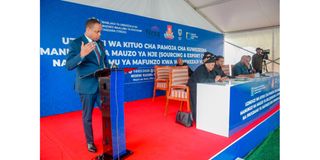
Fredrick Max, Head of Business and Commercial Banking at Stanbic Bank Tanzania, speaking during the launch of the Sourcing and Export Centre, organized by Tanzania Investment and Special Economic Zones Authority, highlighting the bank’s role in enabling trade and connecting Tanzanian businesses to regional and international markets.
Dar es Salaam. Stanbic Bank Tanzania has facilitated trade transactions worth Sh200 billion between Tanzanian and Chinese businesses over the past five years, highlighting its growing role in supporting cross-border trade and investment.
The bank said the deals, executed since 2020, were made possible through collaboration with its parent company, Standard Bank Group, aimed at strengthening financial linkages between Africa and China.
Speaking in Dar es Salaam, Stanbic Bank’s Head of Business and Commercial Banking, Fredrick Max, said the establishment of an Africa–China trade desk by the group inspired the bank to introduce a dedicated Tanzania–China window to better serve local businesses trading with Chinese partners.
“This initiative came at a time when global supply chains were under strain, enabling Tanzanian businesses to continue trading efficiently with their counterparts in China,” he said.
Mr Max added that through the bank’s Biashara Incubator Programme, more than 2,000 entrepreneurs have secured contracts worth Sh32 billion across key development projects nationwide.
He noted that projects such as the East African Crude Oil Pipeline (EACOP) have provided local businesses with reliable market access and strengthened their capital base.
The bank said it remains committed to supporting regional and international trade by helping Tanzanian businesses tap into opportunities under frameworks such as the African Continental Free Trade Area (AfCFTA).
Mr Max was speaking during the launch of a sourcing and export centre by the Tanzania Investment and Special Economic Zones Authority (Tiseza), an event officiated by Kitila Mkumbo, Minister of State in the President’s Office for Planning and Investment.
The event also saw the introduction of a special economic zone training programme targeting young investors, alongside a digital platform through which the minister will engage the public on policy issues.
Prof Mkumbo said the Tanzania Development Vision 2050 places strong emphasis on empowering the private sector to compete globally.
“In line with this vision, the government is supporting micro, small and medium enterprises to produce high-quality goods for export,” he said.
He expressed confidence that the initiatives launched by Tiseza would help nurture a new generation of investors, particularly young people, who make up a significant share of the population.
According to the 2022 Population and Housing Census, about 76 percent of Tanzanians are below the age of 35, underscoring the need for targeted empowerment programmes.
Tiseza Director General Gilead Teri said the programmes were designed to address key challenges facing entrepreneurs, including limited skills, inadequate infrastructure and lack of reliable markets.
“Through these initiatives, we aim to equip young people with entrepreneurship skills and access to production facilities, enabling them to engage in value addition and access both domestic and export markets,” he said.
Mr Teri added that during the 2024/25 financial year, Tiseza registered 940 new projects worth $11 billion, with the potential to create over 342,000 jobs.
He emphasised the need for stronger collaboration between stakeholders, including financial institutions, to expand access to credit and unlock the full potential of Tanzania’s industrial and export sectors.