Tanzania, China deepen state asset management ties through new MoUs
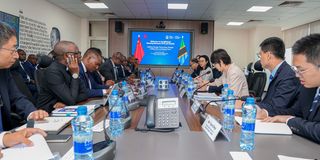
Representatives from the Office of the Treasury Registrar (OTR) and China’s State-owned Assets Supervision and Administration Commission (SASAC) hold a bilateral meeting in Dar es Salaam on August 26, 2026, to discuss areas of mutual cooperation.
Dar es Salaam. Tanzania is set to deepen cooperation with China in the management and supervision of state-owned assets through two Memoranda of Understanding (MoUs) expected to be signed between the Office of the Treasury Registrar (OTR), China’s State-owned Assets Supervision and Administration Commission (SASAC) and the China Enterprise Reform and Development Society (CERDS).
The agreements will establish a framework for technical exchanges, research, capacity building and sharing of expertise on the governance and performance of state-owned enterprises (SOEs).
Treasury Registrar Nehemiah Mchechu said the OTR-SASAC agreement would provide for continuous technical exchanges, while the OTR-CERDS agreement would focus mainly on research and capacity building.
He said the MoUs were expected to be finalised by Friday or Monday next week and would cover areas including policy development, governance reforms, institutional capacity building, research and performance evaluation.
Mr Mchechu was speaking on Wednesday, August 26, 2026, during a bilateral meeting between OTR and SASAC in Dar es Salaam.
The meeting brought together officials from OTR, SASAC and CERDS, as well as Chinese Ambassador to Tanzania Chen Mingjian and senior officials from the Tanzania Ports Authority (TPA), Tanzania Railways Corporation (TRC) and Air Tanzania Company Limited (ATCL).
Mr Mchechu said Tanzania was seeking to draw on China’s experience in supervising state assets, reforming SOEs and improving the efficiency and returns of state capital.
“Through our bilateral relationship with SASAC, we seek to learn how China successfully restructured and concentrated state capital into key strategic sectors to drive national economic growth,” he said.
OTR currently supervises 308 public entities, comprising 252 majority-owned and 56 minority-owned institutions.
CERDS President Peng Huagang said China’s experience showed that SOEs could pursue national strategic interests while operating under market principles.
“State-owned enterprise reform does not mean making SOEs smaller or eliminating them; the goal is to make SOEs stronger, better, and world-class market entities,” Mr Peng said.
He said market-oriented reforms were critical to strengthening the competitiveness of SOEs, while specialised state asset supervision was needed to safeguard public wealth without undermining the operational independence of enterprises.
“Market-oriented reform is the fundamental pathway to enhance SOE competitiveness, enabling them to operate seamlessly alongside other ownership forms,” he said.
Mr Peng said the partnership could also support Tanzania’s development priorities under the Forum on China-Africa Cooperation (FOCAC), particularly in transport, infrastructure, the digital economy and clean energy.
He cited the revitalisation of the Tanzania-Zambia Railway (Tazara) and the expansion of Dar es Salaam Port as potential areas where stronger cooperation could create wider economic opportunities by linking transport infrastructure with mining, agriculture, logistics and industrial centres.
The meeting also examined specific areas in which Tanzanian and Chinese state-owned enterprises could work together.
Tanzania Ports Authority Acting Director General Dr Boniphace Nobeji said improving the efficiency of the country’s ports would have an impact well beyond Tanzania.
“We believe that prosperity of any nation comes from trade and most trade is facilitated by efficient ports. No doubt that improvements in TPA port’s performance and efficiency will fast-track East and Central Africa’s economic development,” Dr Nobeji said.
He identified dry-port development, technology transfer, staff training and benchmarking against Chinese port management practices as potential areas of cooperation.
Tanzania Railways Corporation Director General Machibya Shiwa outlined investment opportunities in freight logistics terminals, private freight operations, railway industrial parks and multimodal logistics hubs.
He also proposed a public-private partnership to construct power transmission lines along railway corridors, with private investors recovering their investment through tariffs linked to cargo transported.
Air Tanzania Company Limited Acting Managing Director and Chief Executive Officer John Nzunda identified aviation logistics, joint maintenance and engineering, digital technology, fuel management and specialised staff training as potential areas of cooperation with Chinese SOEs.
ATCL operates domestic, regional and international passenger and cargo services, including flights to Guangzhou, China.
CCECC East Africa Ltd Executive Director Lu Haiqiang said the company was ready to strengthen cooperation with Tanzanian state-owned enterprises in infrastructure planning, engineering, construction and operations.
He described the revitalisation of Tazara as a major opportunity for broader economic cooperation, saying the railway could strengthen links between strategic trade corridors and mining, agricultural, logistics and industrial centres.