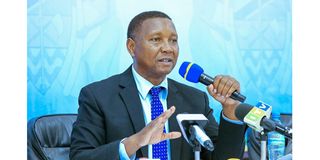
Moshi. The Minister for Education, Science and Technology, Prof Adolf Mkenda, has said he is aware of reports circulating on social media regarding the arrest of a lecturer from the University of Dodoma (UDOM), noting that preliminary information indicates the arrest was related to actions undertaken outside the university, not within the institution.
Reports circulated on social media earlier Saturday, December 13, 2025 claimed that the unnamed lecturer was arrested by police for allegedly inciting students he was teaching on December 8 to participate in demonstrations on December 9, Independence Day.
Speaking to The Citizen's sister paper, Mwananchi on Saturday, December 13, Prof Mkenda said that upon seeing the reports trending online, he contacted relevant authorities to establish their accuracy, adding that the matter is being handled by the responsible authorities.
“I have seen the information circulating on social media about the lecturer being arrested for the reasons being mentioned. I spoke with the Minister for Home Affairs, who said the matter is under investigation. However, preliminary information suggests that the lecturer was arrested due to actions carried out outside the university, not within the institution,” said Prof Mkenda.
He said that lecturers enjoy academic freedom while teaching, provided they adhere to professional standards and ethical conduct, adding that police involvement in classroom teaching is neither expected nor acceptable.
"In principle, lecturers have the freedom to teach, but this must be exercised in line with professionalism and academic ethics. It is not the case that police can enter classrooms to monitor what is being taught. If a lecturer departs from professional or ethical standards, there are internal administrative procedures within universities to address such matters,” he said.
Prof Mkenda further noted that universities have established leadership and governance structures to deal with misconduct, including heads of departments, deputy vice chancellors, faculty deans and senates.
“We do not expect police to be involved in supervising how teaching is conducted in our classrooms. That would be taking matters too far. Such a situation does not exist,” he said.
Prof Mkenda further noted that universities have established leadership and governance structures to deal with misconduct, including heads of departments, deputy vice chancellors, faculty deans and senates.
“We do not expect police to be involved in supervising how teaching is conducted in our classrooms. That would be taking matters too far. Such a situation does not exist,” he said.
He reiterated that lecturers have a responsibility to teach in accordance with professional principles, ethics and competence, stressing that any breach of conduct should be addressed through existing university administrative mechanisms rather than law enforcement intervention.