The fight against malnutrition in Biharamulo is paying off
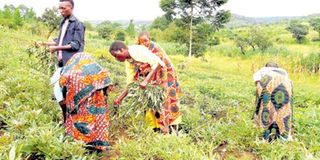
Nutrition With funds from Costech, the district has established an agro-business project for growing nutritious foods (cassava and potatoes)
What you need to know:
Malnutrition, which is defined as “lack of proper nutrition, caused by not having enough to eat, not eating enough of the right things, or being unable to use the food that one does eat” remains a serious problem, mostly affecting children and women.
Biharamulo. Efforts to fight malnutrition in Biharamulo District, Kagera Region in western Tanzania, have started to pay off as prevalence rates have gone down.
This is thanks to the doubling of efforts by various stakeholders to lessen the burden.
Yasinta Brasius, 39, a mother of 10 children and a resident of Musenyi Village in the district, explains her pain at seeing her 6.5-month-old baby suffering from malnutrition.
Malnutrition, which is defined as “lack of proper nutrition, caused by not having enough to eat, not eating enough of the right things, or being unable to use the food that one does eat” remains a serious problem, mostly affecting children and women.
As for Yasinta’s baby, his clinic card indicated that he was underweight as he weighed 5.5kg, which is below acceptable average at her age.
While the average weight for a newly born baby is 3.5kg; at 5 months the weight is supposed to double to at least 7kg and triple upon reaching a year old.
“My baby weighed 3.5kg at birth. As he grew, there was very little weight that he gained. I didn’t know why. I took him to the dispensary for check up, but the findings showed he had no health problem,” she explains.
Lydia Dismas, who is a healthcare provider at the village, confirms that the baby was malnourished even as he was born with normal weight.
“He gained some weight in the first weeks, then suddenly there was a change in the trend. Until March he weighed 5.2kg, which is below what he should have for his age,” Lydia says.
She explains further that her facility has been implementing a health programme that focuses on educating mothers, especially those whose babies were born with low birth weights, on proper dieting to ensure their growth is okay.
“We insist to them that babies must be breast-fed only for the first six months. But, after that age, they must provide them with proper diet. And, they too must eat a balanced diet all the time,” she says.
She adds “When mothers eat a balanced diet, they provide sufficient milk for their babies.”
Lydia says the dispensary embarks on public campaigns to give education on health issues.
Nutritionist’s views
Salum Issa, a nutritionist in Biharamulo District, reveals that at least 10 per cent of babies aged 0-23 months are suffering from malnutrition, referring to recent research findings in the district.
He further reveals that the district has a total of 99,059 children, out of who 37,375 fall within the category of 0-23 months old.
During registration, at least 15,450 households (21 per cent) were registered targeting babies aged 0-23 in which at least 13,750 were registered (37 per cent).
“A thorough preliminary surveillance on clinic cards was conducted. A total of 12,321 babies had normal birth weights (89 per cent), while 1,268 babies had low birth weight (9.2 per cent) and 101 babies were found to have the lowest birth weight accounting for 1 per cent,” he explains.
Agro project aimed at taming malnutrition in Biharamulo
In efforts to address the malnutrition burden in the district, an agro-business project for growing nutritious foods (cassava and potatoes) has been established.
The project is funded by the Tanzania Commission for Science and Technology (Costech).
“We’re encouraged to grow sweet potatoes. To begin with, we will be provided with the sweet potato stems,” she says.
Villagers have been mobilised to grow maize, beans, potatoes, vegetables, among food varieties that are rich in nutrients, reveals Lydia.
Biharamulo District Agriculture officer Gerald Kilaya explains that the project was established in 2017 and involves cassava growers from Kalebezo Village and potatoes growers from Musenyi Village.
He further establishes that potatoes growers were provided with 15,000 potatoes stems/vines per acre, while cassava growers were provided with 4,000 cassava stems per acre.
“The project is aimed at producing enough food to meet nutrition needs of the people and hence eliminate malnutrition burden in the district,” he says.
Costech Knowledge Management acting director Joyce Nyoni says she is satisfied with the progress of the project, saying she is optimistic that the it will transform how agriculture is practised in the district.
“We have been funding various agricultural research projects implemented by research institutions such as Ukiriguru based in Mwanza,” she says.
Joyce further explains that the provided cassava stems and potatoes slips/vines are resistant to drought and diseases.
“Apart from potatoes, we have conducted a thorough research on cassava, maize and banana. The aim is to increase farmers’ yields and produce nutritious food to be consumed by the communities,” she says.
Speaking on behalf of potato growers group dubbed ‘Chapa Jembe’ based in Musenyi Village, Mariana Michael who is its secretary reveals that the group consists of 10 members, six female and four male.
“Our members engage in producing two types of potatoes; kabode and carrot. We work as a team. Apart from agriculture related issues, we also support each other by sharing life experience and find solutions to our key problems,” she says.
Speaking during distribution of potato slips/vines to women whose babies suffer from malnutrition, Biharamulo District Commissioner Saada Malunde admits that previously the district suffered heavily from malnutrition, noting that the efforts her office is taking have started to pay off.
“Statistics show that many people still suffer from malnutrition. It is therefore important to double our efforts. We are pushing to see to it that villagers increase their yields from three to seven tonnes per acre with a view to ensuring sustainable availability of nutritious food in the district,” she says.
“The government continues to look for investors in attempt to revive the collapsed industries. Through medium and big size industries, we can start producing processed products,” she says.
“We have started a process to have land occupancy formalised by acquiring title deeds for Lusahunga plot. Once this process is complete, we will invite investors to come and observe the area. They can build a cassava or potato processing factory, but there is a need to have enough raw materials,” she says.
‘Chapa Jembe’ group chairman Josiah Kagumange confirms that they were given two types of potatoes slips/vines; Kabode and Naspoti, noting that the group members were also trained on modern agricultural methods to increase their yields.
“There are two types of potatoes slips/vines; Kabode and Naspoti, the slips differ in colour and nutrients,” he says.
“Since a new agricultural method, farmers have increased their yields from three to seven tonnes per acre,” he says wearing a broad smile.
He further advises other farmers in the village to adopt the new agricultural practices in order to increase their yields.