Two in five secondary schools in Tanzania lack science labs
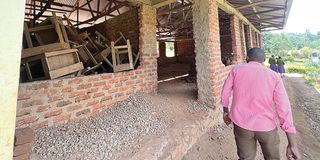
The sole operational laboratory at Ubiri Secondary School in Lushoto District, Tanga Region, with all practical lessons in biology, chemistry, and physics forced into a single classroom. PHOTO | THE CITIZEN REPORTER
Lushoto/Rombo. Two out of every five secondary schools in Tanzania are unable to provide students with adequate practical training in science subjects due to a severe shortage of laboratories.
According to the budget for the Prime Minister’s Office, Regional Administration and Local Government (PMO-RALG) for the 2025/26 fiscal year, the country had 4,894 government secondary schools with 8,710 science laboratories covering biology, chemistry, and physics.
Analysis shows that, based on the total number of schools, 14,682 laboratories should exist.
This leaves a shortfall of 40.68 percent, meaning nearly 2,000 schools operate without any laboratories. Consequently, almost half of all science students are confined to theoretical learning, without access to equipment, experiments, or firsthand observation, as required under the 2020 School Establishment and Registration Guidelines.
Regulation 15 (1)(c) of the guidelines mandates that regional or district education officers verify functional laboratories during school assessments before registration.
For registration, each school must have three laboratories: physics, biology, and chemistry.
Yet, failure to enforce this rule has left teachers and students grappling with daily challenges, while young learners’ ambitions are stifled by inadequate facilities. Some reach Form Four having entered a laboratory only once, often sharing a single piece of equipment among five pupils.
This raises a pressing question: how can Tanzania cultivate the next generation of scientists, engineers, and doctors in a system that restricts practical learning, when science education is fundamentally about discovery, experimentation, and trial and error?
The 40.68 percent laboratory shortfall is more than a statistic; it reflects the reality of government schools operating under tight budgets, in communities that value science education yet face economic limitations.
The situation on the ground
A survey by The Citizen between November 2025 and January 2026 in Lushoto (Tanga Region) and Rombo (Kilimanjaro Region) found that, despite their proximity to Mount Kilimanjaro, these districts rank among the worst for laboratory provision.
While some initiatives exist to enable practical learning, support remains limited. Many schools operate with a single laboratory shared for all three science subjects, affecting both students’ experience and teachers’ workloads. Instructors sometimes rely on weekends to deliver practical lessons.
“There are times when two or three teachers want to use the lab at once. We have to coordinate to avoid conflicts,” said biology teacher Mr Abdallah Thabiti of Mraokeryo Secondary School in Rombo District.
“We now schedule sessions, perhaps you go in now, I later. Sometimes we use extra hours to ensure students receive practical lessons,” he added.
Mr Thabiti’s experience reflects the challenges faced nationwide, where insufficient laboratory infrastructure increases teachers’ workload and compromises teaching quality. He added that searching for materials stored across multiple rooms further reduces time for practical instruction.
A teacher at Makiidi Secondary School in Rombo, Mr John Venance, confirmed that although three laboratories should exist, only one is operational. The lack of dedicated space for each subject, he said, makes practical teaching inadequate. “Infrastructure is unsatisfactory. Equipment such as projectors is missing, and routine exercise samples are often unavailable. According to the skills curriculum, Form One students should have practical lessons immediately, yet many must wait until Form Four,” he said.
Another science teacher at the same school, Ms Perpetua Tesha, explained that practical lessons are prioritised for Form Four students, leaving lower classes reliant on theory.
“We focus on Form Four because they require chemicals or costly materials, while the lower classes use simpler practicals. Teachers share timetables to ensure no student misses out,” she said. At Ubaa Secondary School in Rombo, a teacher, Ms Krisamta Shirima, said locating materials in one room consumes valuable teaching time due to poor storage.
“Even when materials are present, I must search through boxes to experiment, which eats into teaching time,” she lamented.
National perspective
By the 2024/25 fiscal year, PMO-RALG reported 8,710 laboratories, leaving a gap of 5,972 to meet national needs.
The report did not specify numbers per subject, suggesting some sciences face more acute shortages.
PMO-RALG’s Best Education survey released in 2021 indicated Tanzania required 4,081 biology labs, 4,079 chemistry labs, and 4,060 physics labs.
Existing facilities represented roughly 50 percent of the need: 2,033 biology labs, 2,198 chemistry labs, and 1,813 physics labs, with physics particularly under-resourced at 44.6 percent of the requirement.
Why Rombo and Lushoto
The 2017 Best Education survey, the last detailed district-level review, highlighted severe shortages: Lushoto at 92.2 percent, Rombo 76 percent, and Dodoma Municipality 72.5 percent.
Lack of infrastructure
Even where schools possess at least one laboratory, this investigation found that in Rombo and Lushoto, many rooms lacked essential infrastructure.
Students often had no chairs, forcing them to stand during lessons, while other laboratories remained unused for years, dusty and without running water, making practical work impossible. Proper storage is often absent, with all laboratory items kept together, increasing the risk of damage.
“Storage spaces are tight. Physics materials are wood and metal, which endanger biology and chemistry equipment,” said a biology teacher at Lushoto Secondary School, Ms Upendo Ayoub. She added that lack of water complicates experiments: “We need gas for experiments and running water to facilitate lessons.”
At Matoburu Secondary School, teacher Mr Maombi Mahuna said some equipment is stored in locked cabinets or separate rooms due to limited space. “Some materials are locked here, but I do not have the keys. This was meant for chemistry, but usage changes daily depending on needs,” he said. Among the eight schools visited in the two districts, only three had laboratory technicians to assist teachers, who often cover all three subjects across multiple classes. “I coordinate with teachers to prepare experiments before lessons or while students are present,” said a laboratory technician at Shambalai Secondary School in Lushoto, Ms Hawa Rajab.
Students speak out
The shortage has denied students proper practical learning. Form Four student Yosia Enock said he had conducted chemistry experiments only once at this level. “We have never done physics or biology practically. It affects learning because some tasks require lab work. Sometimes we do alternatives,” he said. Form Five student Lucia Vicent added,
“Practical work helps one remember better than theory. Often, we only observe lessons without performing experiments ourselves.”
Mr Yusuph Imam of Motuburu Secondary School in Rombo noted that students rarely enter a laboratory before Form Four.
Local authorities respond
Rombo District Secondary Education Officer, Mr Vianne Mgoma, said the district has 45 government schools with 69 operational laboratories out of 135 required. “To resolve this, funds are received from the central government and allocated by the council to complete laboratory buildings under construction,” he explained.
In Lushoto District, Ms Shahara Shaibu reported that 66 secondary schools have only 58 functional laboratories out of the 198 required: 13 for physics, 30 for chemistry, and 15 for biology.
“The government coordinated construction of three laboratories per school through community effort and allocates funds yearly to complete additional labs,” she said.
Ministry perspective
PMO Deputy Minister, Mr Reuben Kwagilwa, said that during the sixth phase, 1,300 schools were constructed with complete infrastructure, including laboratories.
He noted that out of these, seven are regional schools for boys and 26 science schools for girls. “All schools built in this period have laboratories. Older schools built by communities remain the challenge,” he noted.
He added that over Sh1.3 trillion has been spent on secondary schools and Sh1.5 trillion on primary schools, with older schools gradually being upgraded.
Due to high demand, sometimes only one laboratory is initially constructed for all subjects, with additional labs completed later.
Register to begin your journey to our premium contentSubscribe for full access to premium content