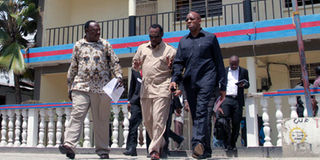
The Coalition of Defenders of the People’s Constitution (Ukawa) leaders (from left) Ibrahim Lipumba (CUF), Freeman Mbowe (Chadema) and James Mbatia (NCCR-Mageuzi) leave the CUF headquarters in Dar es Salaam after a joint news conference yesterday. PHOTO | EMMANUEL HERMAN
What you need to know:
Prof Lipumba says they decided to pull out because the entire process is not backed by national consensus
The decision was announced in Dar es Salaam yesterday by the chairmen of the four parties--Freeman Mbowe (Chadema), James Mbatia (NCCR-Mageuzi), Emmanuel Makaidi (NLD) and Ibrahim Lipumba (CUF). The decision was reached early in the week
Dar es Salaam. Parties affiliated to the Coalition of Defenders of People’s Constitution, or Ukawa in its Kiswahili acronym, will not take part in the Referendum slated for April 30.
The four parties in the union--Chama cha Demokrasia na Maendeleo (Chadema), NCCR-Mageuzi, National League for Democracy (NLD) and Civic United Front (CUF)--will now focus on lobbying the public to support the boycott.
The decision was announced in Dar es Salaam yesterday by the chairmen of the four parties--Freeman Mbowe (Chadema), James Mbatia (NCCR-Mageuzi), Emmanuel Makaidi (NLD) and Prof Ibrahim Lipumba (CUF). The decision was reached at an internal meeting early in the week. The new development comes at a time when there are reservations about the possibility of holding an effective Referendum in April. Leaders who spoke to The Citizen on Saturday argued that the prevailing situation does not support an April Referendum (for more details see separate story).
Speaking in Dar es Salaam yesterday, Prof Lipumba said they decided to pull out because the entire process is not backed by national consensus. Since the beginning of the constitution writing process, he added, the authorities have neglected opinions and suggestions from the opposition.
Political parties, including Chama Cha Mapinduzi, reportedly agreed last year that the Referendum be held in 2016 after the General Election and signed the agreement. And, according to Prof Lipumba, President Kikwete agreed to the deal only to turn around and announce that the Referendum would be held on April 30.
“We are amazed that the President has decided to act against our agreement on a very sensitive issue,” he said. “We had agreed that it should be deferred to a later date.”
To make matters worse, the registration of voters in the new biometric system is lagging because the kits are unavailable. NEC has only 250 BVR kits while it needs 7,750 more to prepare the new voters’ roll. The commission is still waiting for more and there are doubts, it would appear, as to whether the exercise will be completed in time for the April 30 referendum.
Earlier in the week, NEC said its plan to start voter registration on February 16 has not changed and it will finish the work and prepare a new registration book before the Referendum.
But Prof Lipumba says the time left is not enough for civic education and campaigns, given the legal requirements.
“Instead of taking part in an exercise which we are sure will not yield the desired results,” he said, “we have decided to stay out. We cannot be part of writing of an illegitimate constitution.”
Mr Mbowe appealed to all Tanzanians to support their cause and stay away from the referendum which, he claimed, is being forced on the people.
“We cannot turn back and participate in a process we abandoned some months back,” he added. “We cannot be part of sanctioning a constitution which will not serve the purpose.”
Before the referendum, the chief justices of the Union and Zanzibar governments are expected to prepare regulations that provide an opportunity for those not satisfied with the outcome of the referendum to seek legal redress. But they have not met for this purpose to date, said Mr Mbowe--meaning that people who have reservations will not have an opportunity to present their case and the people will have to accept the outcome even if they have serious misgivings.
Mr Mbowe added that, from the look of the things, the entire Katiba-making process appears to have been “hijacked by State House” since it was State House that announced the Referendum date when, according to the law, that is NEC’s job.
According to the Chadema boss, their investigations have established that NEC was not straightforward in the voter registration system using BVR technology given the events during the pilot exercise in Dar es Salaam, Morogoro and Katavi regions.
Mr Mbatia said lack of national consensus on the issue means that the entire process has lost meaning because, in principle, the constitution should be the result of national agreement.
“We cannot take part in the referendum because the remaining time is not enough to make preparations which will assure the country of credible constitution,” he added.