Julius Malema, the law and South Africa’s hard choice
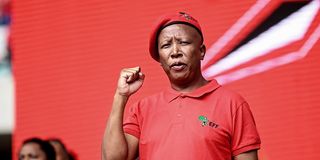
South African opposition politician Julius Malema looks on after he was granted leave to appeal a five-year prison sentence by a magistrate’s court in KuGompo City, South Africa, April 16, 2026. PHOTO | REUTERS
By Anna Tibaijuka
South Africa is once again confronted with a difficult question: how should a democratic state respond when law, politics, and social stability collide?
The legal case against Julius Malema, arising from the discharge of a firearm at a public rally, is not just about one man or one incident. It is about the kind of state South Africa wants to be.
Should it insist strictly on legal punishment, regardless of political consequences? Or should it temper justice with prudence to preserve social cohesion?
At one level, the answer seems obvious. The rule of law demands that all citizens—no matter how powerful—are equal before the law. If the offence is proven, accountability must follow.
A state that bends the law for political convenience risks eroding its own foundations.
But South Africa’s history teaches us something more complex: legality alone does not guarantee legitimacy.
Apartheid was, in its own terms, legal. Its injustice lay not in the absence of law, but in the moral bankruptcy of the system.
This historical experience should make us cautious about equating legal correctness with justice in the broader sense.
It is in this light that the Malema case becomes more complicated.
The involvement of AfriForum as the prosecutor of the case while they are a civil society organization widely perceived as representing narrow minority interests, raises questions of legitimacy.
While legally entitled to pursue private prosecution, AfriForum selective activism fuels a narrative, fair or not, that justice is being weaponised in a politically charged environment.
Perception matters. In a divided society, justice must not only be done; it must be seen to be done fairly.
When large segments of the population view a legal process as politically motivated, the risk is not just disagreement—it is instability.
South Africa has already paid a heavy price for such instability.
The unrest following the imprisonment of former President Jacob Zuma in 2021 led to over 300 deaths.
Crucially, most of those deaths were not caused by the police, but by the breakdown of order: looting, stampedes, and community violence. The lesson is clear: when the state loses control, society itself becomes dangerous.
This is the dilemma. Enforce the law too rigidly, and you risk political escalation. Appear too flexible, and you weaken the authority of the law itself.
How then should South Africa proceed?
Here, African traditions offer valuable guidance. The philosophy of ubuntu reminds us that justice is not only about punishment, but about restoring relationships.
Julius Nyerere’s vision of ujamaa emphasized community, responsibility, and reconciliation. Across the continent, customary systems of justice have long prioritized apology, restitution, and reintegration over purely punitive measures.
South Africa itself embraced this approach during its transition to democracy. The Truth and Reconciliation Commission of President Nelson Mandela did not ignore wrongdoing; it sought to confront it in a way that preserved the nation.
This does not mean abandoning the rule of law. It means applying it with wisdom.
There is also an uncomfortable reality we rarely confront honestly: ignorance of the law remains widespread, even among political elites across Africa. Firearms are sometimes handled casually at weddings and public gatherings, treated as symbols of celebration rather than instruments of lethal force.
This does not make such conduct lawful—it underscores the urgent need for public education.
If this column serves any purpose, it should be to remind citizens and leaders alike that the law on firearms is not decorative.
A gun is not a firework. Its misuse carries consequences not only for the individual, but for public safety. Leaders, in particular, must model lawful conduct, because what they normalise quickly becomes social practice.
A balanced approach would allow the courts to complete their work. If Malema is found guilty, the conviction should stand. But the response need not be maximalist.
A measured outcome—combined with a clear acknowledgment of wrongdoing—could achieve accountability without inflaming tensions.
Indeed, a public apology by Malema would go a long way toward defusing the situation, paving way for a Presidential pardon.
It would affirm respect for the law while avoiding the politics of martyrdom that imprisonment might generate.
Ultimately, South Africa must avoid two equally harmful paths: a rigid legalism that ignores political reality, and a political expediency that undermines the law.
The challenge is to hold both principles together—justice and stability, law and legitimacy.
Balance and realism must guide us. Not because the law is unimportant, but because peace, order, and social cohesion are the very conditions that make the law meaningful in the first place
Prof Anna Kajumulo Tibaijuka is a retired Tanzanian Minister and former United Nations Under-Secretary-General and Executive Director of UN-HABITAT in Nairobi