Tanzania’s top university responds to soft skills warning with practical training plan

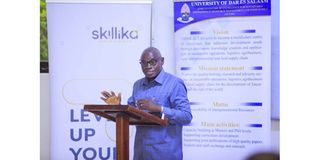
Secretary of UDSM Economics, Agriculture and Business Management Cluster of Industrial Advisory Committee and Principal of College of Agriculture and Food Technology (CoAF), Dr Mkabwa Manoko, speaks during the launch of SKILLIKA programme.

Dar es Salaam. Just days after a national debate was reignited by fresh findings on the soft skills crisis among graduates, the University of Dar es Salaam (UDSM) has unveiled a new partnership that could mark a major turning point in how universities prepare students for work.
On April 21, Tanzania’s oldest and leading university officially launched the UDSM-SKILLIKA Programme, a collaboration with Exact Manpower Consulting Ltd aimed at equipping students with the practical and behavioural skills employers have long said are missing.

The launch comes shortly after a study published in the University of Dodoma’s Journal of Educational Management and Policy Issues revealed a strong link between soft skills and employability, warning that many graduates continue to lose opportunities despite holding academic qualifications.

The new initiative signals that universities are now responding directly to the challenge.

Representing the Deputy Vice Chancellor for Academic, Prof Rose Upor, Dr Flora Magige, said the programme reflects UDSM’s wider reforms to ensure graduates match labour market demands.

“In February 2024, the University published its Industrial Advisory Committee Guidelines to guide engagement with public and private sector actors so that we produce labour market-adaptive graduates and relevant research programmes,” she said.

She added that industry linkages are no longer optional for higher learning institutions.

“Such partnerships enhance teaching for the labour market, strengthen competency-based learning and help institutions meet the skills needs for national development,” she noted.

Dr Magige said the university sees collaboration with industry as a strategic two-way process that supports innovation, technology transfer and knowledge exchange while strengthening Tanzania’s socio-economic progress.

She said curriculum reviews undertaken in the 2024/25 academic cycle were also designed to improve graduate employability.

“We expect one of the outcomes to be greater contribution of universities to Tanzania’s development and competitiveness across sectors,” she said.

At the centre of the new response is a three-stage model that follows students throughout their university journey.

The foundation programme will target first-year students, an intermediate level will support second-year students, while finalists will receive advanced readiness training before graduation.

“This is not a one-day intervention. It is a continuous journey from admission to graduation,” Dr Magige said. “The University fully supports the initiative.”

Exact Manpower Consulting Ltd Managing Director, Mr Kaaya Ndenkunde, said the partnership was born out of a clear reality in the labour market.

“Academic excellence remains essential, but it is no longer sufficient on its own to guarantee workplace effectiveness, career progression or economic independence,” he said.

According to him, employers across sectors continue to deliver the same message: graduates understand theory, but many need structured development in communication, discipline, problem-solving and financial responsibility.

“That gap affects productivity and delays meaningful contribution in the workplace,” he said.

Mr Ndenkunde said SKILLIKA was designed as a deliberate answer to that challenge.

“The emphasis is not on theoretical understanding alone, but on demonstrable competence—how students think, communicate, manage themselves and perform in real-world environments,” he said.

He added that the programme goes beyond helping graduates secure jobs.

“It equips students not only to seek employment, but to operate independently through entrepreneurship, income-generating activities and creating opportunities for others,” he said.

Education experts have welcomed the development, saying it should now be expanded nationwide.

Higher education analyst, Dr Steven Tweve, said the UDSM move shows that universities are beginning to take employability concerns seriously.

“For years, many institutions focused on examinations and certificates. What UDSM has done is recognise that the labour market now rewards capability, not papers alone,” he said.

He said if similar models are adopted across public and private universities, Tanzania could significantly reduce graduate unemployment and underemployment.

“This should not remain a single-campus success story. It needs policy support so every university integrates structured soft skills training into learning,” he added.

Education researcher, Dr Hemed Mvula, said the country has for too long paid the price of ignoring workplace skills.

“When graduates fail interviews, struggle in teams or cannot communicate ideas, the loss is personal, institutional and national,” he said.

He noted that poor employability costs millions of shillings in wasted talent, repeated recruitment processes and lower productivity.

“Closing this gap means better returns on education investment and a stronger economy,” he said.

During the launch, Prof Beatrice Mkenda, Dean of the University of Dar es Salaam School of Economics, referred students to the recent article published in The Citizen on the UDOM study, using it as evidence of why the new programme matters.