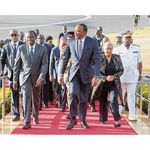
Kenyan President Uhuru Kenyatta and his running mate William Ruto. They will be facing thier old rival, opposition leader Raila Odinga in the August 8 election. PHOTO | FILE
The acrimonious political divorce between President Uhuru Kenyatta and his deputy William Ruto is no longer new
Some commentators have pointed out to some parallels between succession politics which unfolded within CCM in 2015 where the runaway favourite to replace former president Jakaya Kikwete did not make the cut, so when the political dust settled, the party had settled for someone else
Kenyans will go to the polls in August but one can be forgiven for not being sure when the election campaigns started or for being surprised at the fact that ‘they have not voted yet’ even though they election campaigns have been a common news feature for years. The acrimonious political divorce between President Uhuru Kenyatta and his deputy William Ruto is no longer news.
From the outside looking in, it is easy to conclude that such a scenario cannot happen in another neighbouring country.
After all, our contexts and politics are ‘different’. However, the reality might not be so different after all even with varied contexts, the underlying theme is the same; the region, in the context of the East African Community (EAC) does not do well when it comes to political transitions.
They are exciting but in a continent where political changes can be bloody affairs, are dreaded by those who find such unpredictability to be problematic. It is a continent that seeks stability.
The post-colonial realities of many countries on the continent are such that power is rarely transferred from one ruler to another in a peaceful or orderly manner. There have been bloody coups or attempted ones, contested election outcomes or armed rebellions seeking to topple or successfully toppling rulers in place. The peaceful handover of power has been a common feature mostly in countries with the same ruling party. The few countries on the continent which have achieved peaceful transfer of power between different political parties are few and still an anomaly.
The political drama unfolding in Kenya with its succession politics while different, it is not something unfamiliar in the region. Some commentators have pointed out to some parallels between succession politics of 2015 in Tanzania which unfolded within CCM where the runaway favourite to replace former president Jakaya Kikwete did not make the cut, so when the political dust settled, the party had settled for someone else.
This choreographed succession masks the bitter political fights each time a president is retiring and in many cases even when the incumbent president is running for a second term, the rumours of possible challengers or being outmaneuvered by deal makers within their own party do the rounds.
The majority of the countries in the region have gone through terrible and tragic chapters in the past. Some, like South Sudan are still living a nightmare. Even the soon-to-be- newly minted EAC partner state in the Democratic Republic of Congo, succession politics is still fraught with challenges.
Burundi has managed the most presidents with ten. However, that has not translated into ‘quiet’ successions nor has it banished thoughts coups or rebellions. Uganda has had nine presidents with the incumbent ruling longest than all his predecessors combined and still there are fears of what comes after him and the succession is a delicate issue. There have been four presidents in Rwanda and given their tragic past and decades of massacre episodes, it is not surprising that they would wish the current president stays for as long as he can.
In other words, the region is still ‘new’ at succession politics regardless of how long a particular country has managed to transfer power from one president to another. Coups or attempted coups have not delivered stability. Successful armed rebellions have not solved the question of peaceful succession politics. Elections in much of the region are something that evokes fears, bad memories and demons coming out of the shadows. The processes in much of the region are contested, flawed and nothing short of what one analyst referred to as ‘performing to the gallery’, that they are not reflective of the realities on the ground and has more to do with gaining legitimacy from the watchful eyes in the gallery.
The politics of succession will continue to cause anxieties to many in the region, not least because to those inhabiting the political space, politics is considered a zero sum game.